

Getting funded as a retail trader sounds like a dream opportunity, but the reality is far more selective. Only around 7% of traders receive payouts after attempting prop firm evaluations, a statistic that challenges the notion that funding is easily accessible. This article breaks down why prop firms fund retail traders, how evaluation challenges filter for discipline and skill, and what the business model really looks like. You’ll discover the funding mechanisms, strict challenge rules, critical perspectives, and practical benefits that define this growing sector of retail trading in 2026.
Table of Contents
- How Prop Firms Fund Retail Traders And Why
- The Strict Evaluation Challenges That Select Funded Traders
- The Realities And Criticisms Of Retail Trader Funding Models
- Why Retail Traders Still Pursue Funding And How To Benefit
- Explore DayProp Funding For Retail Traders
- Frequently Asked Questions
Key takeaways
| Point | Details |
|---|---|
| Revenue model | Prop firms profit primarily from evaluation fees and profit splits, not trader payouts. |
| Strict filtering | Only 5-14% pass challenges due to tight profit targets and drawdown limits. |
| Risk management | Simulated accounts and strict rules minimize firm exposure while testing trader discipline. |
| Trader benefits | Access to $10k-400k capital with 70-90% profit splits rewards successful traders. |
| Critical view | High failure rates and fee-driven models raise concerns about misaligned incentives. |
How prop firms fund retail traders and why
Prop firms don’t hand out capital freely. They fund retail traders through a carefully structured business model built on evaluation fees, profit splits, and controlled risk. The core revenue stream comes from traders paying upfront to attempt evaluation challenges, which typically range from $100 to $1,000 depending on the account size. These fees represent the primary income source because most traders never reach the payout stage.
When traders do succeed, firms implement profit splits ranging from 10% to 30% of trading gains, though many competitive platforms now offer 70-90% to traders. This split allows firms to share in profitable trading while maintaining a revenue channel beyond evaluation fees. Additional income streams include broker commissions on trading volume and subscription models for ongoing account access.
The genius of this model lies in risk mitigation. Most prop firms use simulated trading accounts rather than deploying actual capital during evaluations. This means traders execute real trades in live market conditions, but the firm’s financial exposure remains minimal until a trader proves consistent profitability. Only after passing strict evaluation phases do some firms transition traders to live capital or continue with simulated accounts that pay real profits.
Strict trading rules further reduce risk. Firms enforce daily drawdown limits, maximum loss thresholds, and specific trading hour restrictions that filter out reckless behavior. These parameters ensure only disciplined traders who demonstrate proper risk management advance to funded status. The proprietary trading models vary across platforms, but the underlying principle remains constant: scalable talent assessment with controlled downside.
This business structure allows prop firms to evaluate thousands of traders simultaneously while risking minimal capital. The low payout rate means evaluation fees from the majority of participants subsidize the funding and profit splits paid to the small percentage who succeed. It’s a volume-based model where firms profit from scale, not individual trader failure, though critics argue the distinction matters less when outcomes heavily favor the house.
Key funding sources:
- Evaluation challenge fees (primary revenue)
- Profit splits from successful traders
- Broker commissions on trading volume
- Monthly subscription or account maintenance fees
- Upsells for larger account sizes or faster evaluations
The strict evaluation challenges that select funded traders
Evaluation challenges function as high-stakes filters designed to identify traders with genuine skill and discipline. These challenges typically require traders to hit profit targets of 5-10% while respecting strict risk parameters. For example, a $100,000 evaluation account might demand an 8% gain ($8,000) to pass Phase 1, followed by another 5% ($5,000) in Phase 2 before receiving funding.

The real difficulty lies in the drawdown limits that accompany these profit targets. Daily drawdown limits typically range from 4-6%, meaning if your account drops by this percentage in a single trading session, you fail immediately. Maximum drawdown limits of 5-12% apply across the entire evaluation period, creating a narrow margin for error. These dual constraints force traders to balance aggressive profit seeking with defensive risk management.
Consistency requirements add another layer of difficulty. Many firms prohibit traders from achieving their profit target in a single trade or day, requiring a minimum number of trading days to demonstrate repeatable edge rather than lucky timing. Some platforms enforce maximum position sizing, restrict trading during high-impact news events, or ban certain high-risk strategies like martingale systems.
The combination of these rules explains why pass rates hover between 5-14% across the industry. Traders must navigate live market volatility while operating within parameters tighter than most retail accounts. The challenge isn’t just making money; it’s making money the right way, with controlled risk and consistent execution that mirrors institutional trading standards.
Pro Tip: Successful traders typically risk less than 2% of account equity per trade during evaluations, allowing multiple consecutive losses without hitting drawdown limits while maintaining enough position size to reach profit targets within reasonable timeframes.
Typical challenge requirements:
- Achieve profit target (5-10% depending on phase)
- Respect daily drawdown limit (4-6% maximum loss per day)
- Stay within maximum drawdown (5-12% total account loss)
- Trade minimum number of days (usually 3-5)
- Follow platform-specific rules (position sizing, trading hours, instruments)
- Avoid prohibited strategies (hedging, martingale, news trading)
These structured parameters serve dual purposes: they protect the firm from reckless traders while simultaneously building discipline in participants. Even traders who fail often report improved risk management from using trading rules that force better habits than their previous self-directed trading.
The realities and criticisms of retail trader funding models
Not everyone views retail prop trading as a legitimate path to professional trading. Critics point to failure rates exceeding 95% as evidence that the model functions more as fee extraction than genuine trader development. When only 5-7% of participants ever receive payouts, the business clearly profits from the many who fail rather than the few who succeed.
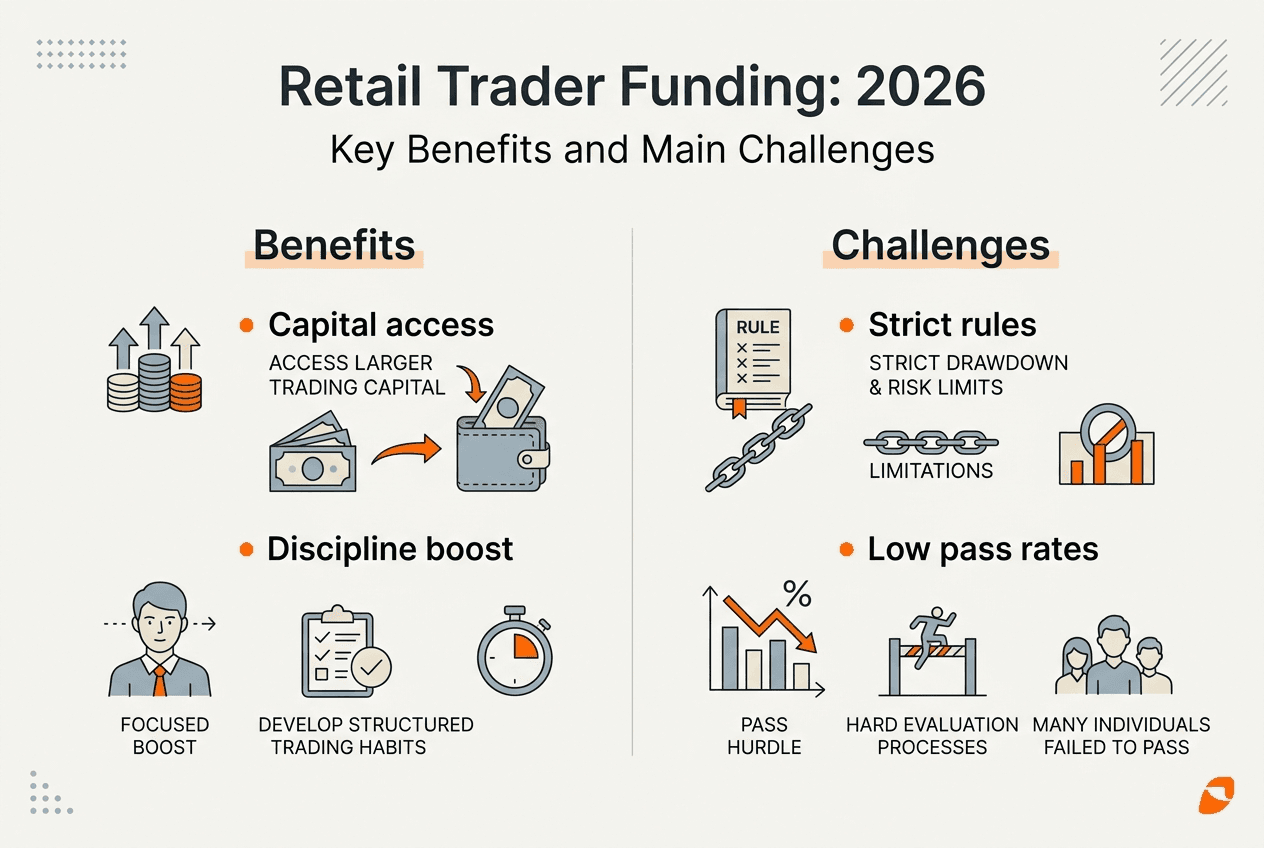
The use of simulated accounts raises fundamental questions about whether firms truly “fund” traders at all. Many platforms never deploy actual capital, instead paying successful traders from the pool of evaluation fees collected from unsuccessful participants. This creates a business model closer to a trading competition than traditional proprietary trading, where firms risk their own capital on trader performance.
Gameification elements amplify these concerns. The challenge structure encourages traders to pay repeatedly for new attempts after failures, creating a cycle that benefits the firm regardless of individual outcomes. Some platforms offer discounts on retries or create urgency through limited-time promotions, tactics that critics argue exploit the psychological vulnerabilities of aspiring traders rather than serving their development.
The contrast with institutional prop trading is stark. Traditional prop shops invest heavily in trader training, provide mentorship, and risk firm capital from day one. Traders receive salaries during development and keep a smaller profit split because the firm bears real financial risk. Retail prop firms invert this model: traders pay the firm, receive minimal training, and bear all financial risk through evaluation fees while firms maintain profit regardless of outcomes.
“The retail prop firm model profits primarily from trader failures through evaluation fees, often using simulated accounts that avoid capital risk while creating the appearance of funding opportunities. This misaligns incentives compared to true proprietary trading where firms invest in and risk capital on their traders.” – Industry analysis
Regulatory concerns add another dimension. Some jurisdictions question whether these platforms should be classified as trading education, gambling, or financial services, each carrying different oversight requirements. The lack of clear regulation allows wide variation in transparency, payout reliability, and business practices across the industry.
Despite these criticisms, defenders argue the model provides valuable structure and capital access for traders who might never qualify for institutional positions. The question becomes whether the benefits justify the costs and risks, a calculation each trader must make individually. Understanding prop trading alternatives helps contextualize where retail prop firms fit within the broader landscape of trading opportunities.
| Feature | Retail Prop Firms | Institutional Prop Trading |
| — | — | |
| Capital risk | Trader pays fees; firm uses simulated accounts | Firm risks own capital on trader positions |
| Revenue model | Evaluation fees and profit splits | Profit from successful trading only |
| Training | Minimal; self-directed | Extensive mentorship and development |
| Trader compensation | 70-90% profit split after passing | Salary plus smaller profit split |
| Pass rate | 5-14% of applicants | Selective hiring but higher success |
Why retail traders still pursue funding and how to benefit
Despite valid criticisms, thousands of retail traders pursue prop firm funding for compelling practical reasons. The primary draw is capital access ranging from $10,000 to $400,000 without personal financial risk beyond evaluation fees. For traders with proven strategies but limited capital, this represents a shortcut to professional-level position sizing that would take years to build through personal account growth.
Profit splits of 70-90% mean successful traders keep the vast majority of their gains while trading significantly larger accounts than they could fund personally. A trader with a $5,000 personal account might generate $500 monthly at 10% returns. That same trader with a $100,000 funded account earning 5% monthly produces $5,000, keeping $4,000-4,500 after the profit split. The math becomes attractive quickly for consistently profitable traders.
The structured challenge environment builds discipline that many traders lack when self-directing. Strict drawdown limits and profit targets force better risk management, position sizing, and emotional control than the unlimited freedom of personal accounts. Even traders who fail evaluations often report improved trading habits from operating within professional parameters.
Scalability represents another significant advantage. Most prop firms offer account scaling programs where successful traders can grow from $25,000 accounts to $200,000 or more based on consistent performance. This progression path mirrors institutional trading careers, providing clear milestones and growth opportunities tied directly to results.
Access to multiple markets enhances opportunity. Prop firms typically offer FX pairs, major indices, commodities, and increasingly crypto markets within single platforms. This diversification allows traders to follow opportunities across asset classes without maintaining separate brokerage accounts or meeting different minimum capital requirements.
Pro Tip: Approach prop firm funding as a skill development investment rather than a get-rich-quick scheme. Traders who master essential trading skills before attempting evaluations show significantly higher pass rates than those treating challenges as lottery tickets.
Primary benefits driving participation:
- Capital access without personal financial risk
- High profit splits (70-90%) on larger accounts
- Structured rules that build trading discipline
- Scalability based on proven performance
- Multi-market access (FX, indices, crypto)
- Professional trading environment and parameters
The key to benefiting from prop firm funding lies in realistic expectations and proper preparation. Traders should develop consistent profitability on personal or demo accounts before paying evaluation fees, ensuring their strategy and psychology can handle the challenge parameters. Understanding that firms profit primarily from fees rather than trader success helps frame the relationship accurately, neither as predatory nor as charitable opportunity.
Successful funded traders typically combine technical skill with emotional discipline and risk management. They treat evaluations as job interviews requiring demonstration of professional competence rather than spectacular gains. This mindset shift from gambling to business substantially improves outcomes and helps traders extract genuine value from the prop firm model despite its structural limitations.
Explore DayProp funding for retail traders
If you’re ready to test your trading discipline under professional parameters, DayProp offers transparent evaluation challenges designed to identify and reward consistent traders. Our structured approach combines clear rules with competitive profit splits, giving you the framework to demonstrate your edge in FX, indices, and crypto markets.
We’ve built our platform around the principle that real trading skill deserves real funding. Our performance-based trading evaluation guide walks you through exactly what we assess and how to prepare effectively. Whether you’re starting with our $25,000 funding challenge or exploring larger account sizes, you’ll find detailed requirements and transparent rules at every level. Check out our comprehensive trading evaluation guide to understand the complete process from challenge to payout and position yourself for success.
Frequently asked questions
What is the success rate for retail traders getting funded?
Only about 5-14% of traders pass prop firm evaluation challenges, with roughly 7% ultimately receiving payouts after completing all phases. The strict profit targets combined with tight drawdown limits filter out the majority of participants. Success requires disciplined risk management, consistent execution, and the emotional control to trade within professional parameters rather than seeking spectacular gains.
How do prop firms manage risk when funding retail traders?
Prop firms enforce daily drawdown limits of 4-6% and maximum drawdown thresholds of 5-12% that automatically terminate accounts exceeding these losses. Most platforms use simulated trading accounts during evaluations, eliminating direct capital exposure while traders prove consistency. These strict trading rules ensure only disciplined traders who demonstrate proper risk management advance to funded status, protecting firms from reckless trading behavior.
What are the main criticisms of retail prop trading models?
Critics highlight that over 95% of traders fail evaluations, meaning firms profit primarily from fees rather than successful trader development. Many platforms use simulated accounts rather than deploying real capital, questioning whether they truly “fund” traders at all. The business model can create misaligned incentives where firms benefit from repeated evaluation attempts, contrasting sharply with institutional prop trading where firms risk their own capital on trader performance.
How much capital can retail traders access through prop firms?
Funded account sizes typically range from $10,000 to $400,000 depending on the evaluation level and platform. Most traders start with smaller accounts between $25,000 and $100,000, then scale up based on consistent profitable performance. Scaling programs allow successful traders to grow their funded capital over time, with some platforms offering accounts exceeding $500,000 for top performers who demonstrate sustained edge and risk management.
What profit split can funded traders expect?
Most competitive prop firms now offer profit splits of 70-90% to traders, with the firm keeping 10-30%. Some platforms start at lower splits like 70% and increase to 90% as traders prove consistency or reach higher account tiers. This structure rewards successful traders with the majority of gains while allowing firms to profit from the small percentage who achieve funded status and generate consistent returns.
Recommended
- Types of proprietary trading models for retail traders in 2026 – DayProp Funding
- Compare trader funding models to find your best fit 2026 – DayProp Funding
- Why traders need professional risk management in 2026 – DayProp Funding
- Role of structured trading: Boost discipline and funding – DayProp Funding