

The trading landscape has fundamentally shifted. Bitcoin’s correlation with Nasdaq 100 has risen to 0.62, showing crypto as a high growth tech asset, while gold exhibits a negative correlation with stocks acting as a hedge. If you’re trading only one instrument in 2026, you’re missing critical opportunities and exposing yourself to unnecessary risk. Multi-instrument trading isn’t just an advanced technique anymore, it’s essential for securing funding and achieving sustainable growth.
Table of Contents
- How 2026’s Unique Market Environment Drives Multi-Instrument Trading
- Diversification Benefits: Managing Risk And Capturing Opportunities Across Instruments
- Multi-Strategy Approaches Within Crypto And Beyond: Flexibility And Adaptability
- Asset-Vs-Asset Trading: Expressing Relative Value With Reduced Directional Risk
- Unlock Funding And Growth By Mastering Multi-Instrument Strategies
- Frequently Asked Questions About Trading Multiple Instruments
Key takeaways
| Point | Details |
|---|---|
| Diversification reduces risk | Trading multiple instruments with low or negative correlations smooths returns and minimizes drawdowns during market stress. |
| Market conditions demand flexibility | Central bank divergence, geopolitical tensions, and evolving crypto adoption create distinct opportunities across asset classes. |
| Multi-strategy approaches enhance adaptability | Combining spot, futures, and options strategies within instruments helps traders navigate different volatility regimes. |
| Asset-vs-asset trading minimizes exposure | Relative value strategies reduce directional risk while capturing momentum between correlated instruments. |
| Funding evaluations favor disciplined diversification | Prop firms recognize traders who demonstrate risk management across multiple markets and strategies. |
How 2026’s unique market environment drives multi-instrument trading
The financial landscape in 2026 features a resilient but slowing U.S. economy, diverging central bank policies, increasing institutional crypto adoption, and ongoing geopolitical tensions. These factors create distinct trading opportunities across different asset classes that single-market traders simply cannot access.
Consider these defining characteristics of the current market:
- U.S. GDP growth moderating to 1.8–2.2% while tech sector valuations remain elevated
- Federal Reserve maintaining restrictive policy while other central banks begin easing cycles
- Institutional crypto adoption accelerating through ETFs and corporate treasury allocations
- Geopolitical risks driving safe-haven demand for gold and volatility in energy markets
- VIX hovering in the 16–22 range, signaling moderate volatility with periodic spikes
These dynamics create non-correlated profit opportunities. When tech stocks face pressure from high rates, gold is the highest-conviction trade due to central bank buying and geopolitical risk premiums. Meanwhile, crypto markets respond to completely different catalysts like regulatory clarity and blockchain innovation.
Traders focused solely on FX pairs miss the explosive moves in indices during earnings seasons. Those trading only crypto miss defensive opportunities when risk-off sentiment dominates. A comprehensive indices trading strategy combined with commodity and crypto exposure positions you to profit regardless of which macro theme dominates.
Pro Tip: Track correlation matrices weekly. When traditional correlations break down during regime shifts, the biggest opportunities emerge for multi-instrument traders who can pivot quickly.
Diversification benefits: managing risk and capturing opportunities across instruments
Diversification means holding positions across assets that respond differently to market conditions. In 2026’s complex environment, this principle has never been more critical. Portfolio diversification reduces risks and captures opportunities missed by single-market tactics.
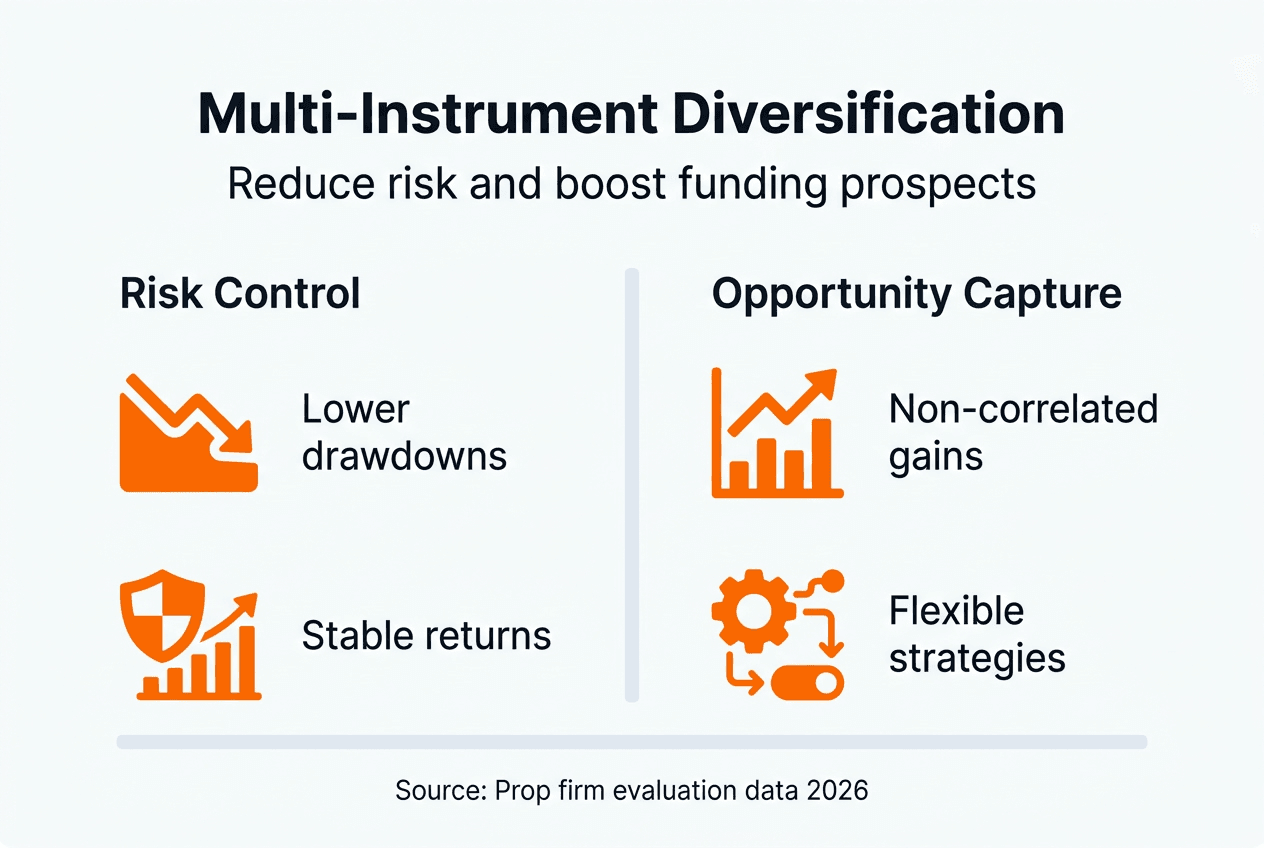
The math is compelling. When one asset class experiences drawdowns, uncorrelated or negatively correlated assets can offset losses. Traditional stock/bond mixes have become less reliable, with gold and emerging market stocks moving opposite during downturns, showing value of broader assets.
| Asset Class | Primary Role | Typical Correlation to S&P 500 | Best Environment |
|---|---|---|---|
| U.S. Indices | Growth engine | 1.00 (self) | Risk-on, earnings growth |
| Gold | Hedge/safe-haven | -0.15 to -0.30 | Geopolitical stress, inflation fears |
| Bitcoin/Crypto | High-beta growth | +0.60 to +0.70 | Liquidity expansion, tech momentum |
| FX Majors | Relative value | Variable (-0.40 to +0.50) | Policy divergence, carry opportunities |
| Commodities | Inflation hedge | +0.20 to +0.40 | Supply constraints, reflationary periods |
This correlation structure reveals why diversification works. When indices sell off on recession fears, gold often rallies. When crypto corrects on regulatory concerns, FX carry trades may thrive on interest rate differentials. You’re not hoping one market cooperates, you’re positioned to profit from whichever theme dominates.
Key reasons to diversify your trading instruments:
- Reduced portfolio volatility through uncorrelated return streams
- Access to distinct volatility regimes and liquidity patterns across markets
- Ability to express both directional and relative value views
- Protection against single-market catastrophic events or flash crashes
- Enhanced learning curve from observing inter-market dynamics
Traders who manage trading risk across multiple instruments demonstrate the discipline prop firms seek. You’re not gambling on one market’s direction, you’re systematically harvesting opportunities wherever they appear.
Multi-strategy approaches within crypto and beyond: flexibility and adaptability
Trading a single instrument with one strategy limits your edge. Combining multiple strategies within and across instruments creates flexibility that separates funded traders from those who struggle. This approach shines brightest in crypto markets, where volatility regimes shift rapidly.
Multi-strategy crypto portfolios smooth returns and reduce drawdowns by combining spot holdings, leveraged futures, staking yield, and options strategies. Each component serves a distinct purpose:
- Spot holdings: Core long-term exposure to blue-chip crypto assets during bull cycles
- Futures contracts: Leveraged directional plays and hedging tools for existing positions
- Staking/yield strategies: Passive income generation during sideways or accumulation phases
- Options: Volatility trading, defined-risk speculation, and income through covered calls
The magic happens when these strategies work together. During high volatility, options premiums spike while spot positions may consolidate. During trending markets, futures amplify gains while staking provides steady carry. Combining strategies allows traders to adapt to regime changes like high or low volatility or liquidity stress.
This same principle applies beyond crypto. In indices, you might combine:
- Swing trades on weekly support/resistance levels
- Intraday scalping during high-volume sessions
- Long-term trend following on major indices
- Short-term mean reversion plays during overextended moves
Complexity demands discipline. You must track P&L by strategy, monitor margin requirements across instruments, and maintain clear position limits. The challenge isn’t executing more trades, it’s managing the operational overhead of multiple strategies without losing focus.
Pro Tip: Start with two complementary strategies in one instrument before expanding. Master spot and futures in Bitcoin before adding options. Prove your edge in one market before replicating across others. This phased approach supports trading account growth without overwhelming your risk management systems.
Asset-vs-asset trading: expressing relative value with reduced directional risk
The most sophisticated multi-instrument approach involves trading one asset against another, capturing relative performance while minimizing overall market exposure. This technique transforms how you think about opportunity and risk.

Asset-vs-asset trading allows traders to express views on relative strength, reducing directional market exposure and enabling focus on correlation and momentum. Instead of betting Bitcoin rises, you bet Bitcoin outperforms Ethereum. Instead of predicting Nasdaq rallies, you predict Nasdaq outperforms S&P 500.
| Approach | Market Exposure | Primary Risk | Profit Driver | Complexity |
|---|---|---|---|---|
| Directional | Full directional | Absolute price movement | Correct market direction | Low |
| Asset-vs-Asset | Reduced/neutral | Relative performance | Spread widening/narrowing | Medium |
| Market-neutral pairs | Minimal directional | Execution and correlation breakdown | Pure relative momentum | High |
The advantages compound quickly:
- Simplified position management by focusing on spread behavior rather than absolute levels
- Reduced sensitivity to broad market crashes that affect all assets similarly
- Ability to profit in sideways markets where directional trades stagnate
- Enhanced risk-adjusted returns through lower volatility relative to outright positions
- Natural hedging that protects capital during unexpected events
Consider a practical example from early 2026. You believe tech will outperform value in a low-rate environment. Instead of going long Nasdaq with full directional risk, you go long Nasdaq and short Russell 2000 in equal risk-weighted amounts. If markets crash, both positions lose value but your spread trade remains profitable if tech merely falls less than small caps.
This approach directly supports funding evaluations. Prop firms reward traders who demonstrate real trading skill through risk-adjusted performance, not lucky directional bets. Asset-vs-asset strategies prove you understand market structure and relative value, not just momentum chasing.
Pro Tip: Start with versus pairs within a single instrument class like crypto. Trade BTC/ETH or ETH/SOL spreads before expanding to cross-asset pairs like tech stocks versus gold. This narrows your learning curve while building relative value intuition.
Unlock funding and growth by mastering multi-instrument strategies
The path to consistent profitability and funded trading accounts runs through multi-instrument mastery. You’ve seen how 2026’s market conditions create distinct opportunities across FX, indices, crypto, and commodities. You understand how diversification reduces risk while multi-strategy approaches enhance adaptability. You’ve learned how asset-vs-asset trading minimizes directional exposure while capturing relative value.
Now it’s time to put these concepts into practice with structured evaluation and expert guidance. DayProp’s performance-based trading evaluation process guide walks you through demonstrating your edge across multiple instruments under professional risk parameters. Our trading evaluation guide secure prop funding provides the roadmap from retail trader to funded professional. Before you start, compare trader funding models to find the evaluation structure that matches your multi-instrument approach. The market rewards preparation, discipline, and diversified skill.
Frequently asked questions about trading multiple instruments
What is the main advantage of trading multiple instruments?
The primary advantage is risk reduction through diversification of return streams that respond to different market catalysts. When one asset class experiences drawdowns, uncorrelated positions can offset losses while capturing opportunities in their respective markets. This smooths your equity curve and improves risk-adjusted returns, which funding evaluations specifically reward.
How does asset-vs-asset trading reduce risk?
Asset-vs-asset trading reduces risk by eliminating or minimizing directional market exposure, focusing instead on relative performance between two instruments. If both assets fall during a market crash but one falls less, your spread trade remains profitable. This approach protects capital during systemic events while allowing you to express views on relative strength, correlation, and momentum without full directional risk.
Can trading multiple instruments improve chances of securing trading funding?
Absolutely. Prop firms seek traders who demonstrate consistent risk management and adaptable strategies across market conditions. Trading multiple instruments proves you can identify opportunities beyond a single market, manage complexity, and adjust to changing regimes. This versatility signals professional skill rather than single-market luck, making you a more attractive candidate for funding and account scaling.
What challenges arise from multi-strategy portfolios?
The main challenges include operational complexity in tracking multiple positions, increased margin requirements across instruments, and the cognitive load of monitoring different markets simultaneously. You must maintain strict position limits, track P&L by strategy, and avoid overtrading when opportunities appear across all instruments. Success requires robust trade journaling, clear allocation rules, and disciplined execution systems.
How do correlations affect diversification benefits?
Correlations determine how much risk reduction you achieve through diversification. Assets with low or negative correlations provide the greatest diversification benefit because they respond differently to market events. When correlations rise during market stress, diversification benefits temporarily decrease. Effective multi-instrument trading requires monitoring correlation matrices and adjusting position sizing as relationships shift between normal and crisis regimes.
Should I trade all available instruments or specialize in a few?
Start by mastering two to three instruments with distinct correlation profiles before expanding further. Deep expertise in FX majors, one major index, and Bitcoin provides sufficient diversification while keeping complexity manageable. As you prove consistent profitability, gradually add instruments like gold or additional crypto assets. Quality of execution across a focused set outperforms mediocre execution across dozens of markets.
Recommended