

TL;DR:
- Scalable funding provides trading capital based on performance, minimizing personal financial risk.
- Most traders face strict rules, high failure rates, and challenge fees that can outweigh payouts.
- Success relies on discipline, risk management, and viewing challenges as professional evaluations.
Many traders enter the world of proprietary funding with one assumption: that scalable funding is a fast, low-effort path to trading large accounts. The reality is more complex. Hidden fees, strict drawdown rules, and low success rates catch most newcomers off guard. This guide is designed to cut through the noise and give you a clear, factual picture of how scalable funding works, what it actually costs, where the real risks lie, and how disciplined traders can position themselves for long-term success. Whether you trade FX, indices, or crypto, understanding these mechanics before you commit is essential.
Table of Contents
- What is scalable funding?
- How scalable funding programs work
- Benefits and risks of scalable funding
- How to maximize your impact with scalable funding
- A unique perspective: the uncomfortable truth about scalable funding
- Explore funding solutions tailored for traders
- Frequently asked questions
Key Takeaways
| Point | Details |
|---|---|
| Capital access without personal risk | Scalable funding lets traders grow without risking their own money, but fees and rules apply. |
| Challenge fees fund the system | Most fees go toward losses and payouts, so understand where your money flows before starting. |
| Success requires strict discipline | Very few traders secure funded accounts; consistent risk management and adherence to rules is key. |
| Look past the hype | Not all profits are real, and payouts often come from fee pools rather than trading gains. |
What is scalable funding?
Scalable funding refers to a structured system where traders gain access to increasing amounts of trading capital based on their demonstrated performance, rather than depositing their own money into a brokerage account. The concept is straightforward: a funding firm or proprietary trading platform provides the capital, and the trader earns a share of the profits generated from trading that capital.
The appeal is clear. Instead of spending years accumulating personal savings to trade meaningful position sizes, a skilled trader can access accounts ranging from $10,000 to well over $1,000,000 by proving their ability through a structured evaluation process. As performance improves and specific milestones are met, the account size increases, which is the “scalable” element that attracts so many retail traders.
There are several types of scalable funding programs available today:
- Evaluation-based prop firm programs: Traders complete one or two-phase challenges, meeting profit targets while staying within defined risk limits.
- Instant funding models: Traders pay a higher fee to skip the evaluation and receive a funded account immediately, though often with lower profit splits.
- Subscription-based models: Traders pay recurring fees to maintain access to funded account status and scale as they hit milestones.
- Revenue-sharing programs: Firms offer capital in exchange for a share of profits, often with stricter performance benchmarks.
Each model has distinct rules, fee structures, and scaling criteria. The most common format seen in the market today is the evaluation challenge, where a trader must hit a profit target (typically 8 to 10 percent) without breaching a maximum drawdown (typically 5 to 10 percent).
As scalable funding can grant traders access to capital without personal risk, it has become one of the most discussed topics in the retail trading community. The ability to trade without putting your savings on the line is genuinely attractive, especially for traders who have an edge but lack sufficient capital to make meaningful returns at a retail account size.
The core advantage of scalable funding is not just the capital itself. It is the ability to demonstrate real trading skill in a structured environment while removing the personal financial risk that has historically limited talented retail traders.
For those researching funded trader strategies, understanding the different pathways available is the logical starting point before evaluating which model best fits your trading style and risk tolerance.
How scalable funding programs work
Understanding the mechanics of scalable funding programs is critical before committing any money to a challenge fee. The process follows a defined sequence, and knowing each step in detail reduces costly surprises.
Here is a step-by-step breakdown of how most evaluation-based scalable funding programs operate:
- Application and program selection: The trader selects an account size (e.g., $25,000, $50,000, or $100,000) and pays a corresponding challenge fee. Larger accounts require higher fees.
- Phase one challenge: The trader must hit a defined profit target (typically 8 to 10 percent) within a set number of trading days, while staying within daily and overall drawdown limits.
- Phase two verification: A second, lower-target phase (typically 5 percent) confirms the trader can perform consistently, not just get lucky in one phase.
- Funded account activation: Traders who pass both phases receive access to a funded account. However, trading conditions may differ from the challenge environment.
- Profit withdrawal and scaling: As the trader meets performance milestones, the account size increases. Profit splits at this stage typically range from 75 to 90 percent in favor of the trader.
- Scaling cap or ceiling: Most programs have a maximum account size limit, often between $500,000 and $2,000,000 for top performers.
Most funding programs require challenge fees ranging from $100 to $500, with only a small percentage of traders ultimately earning real-money accounts after completing all phases.
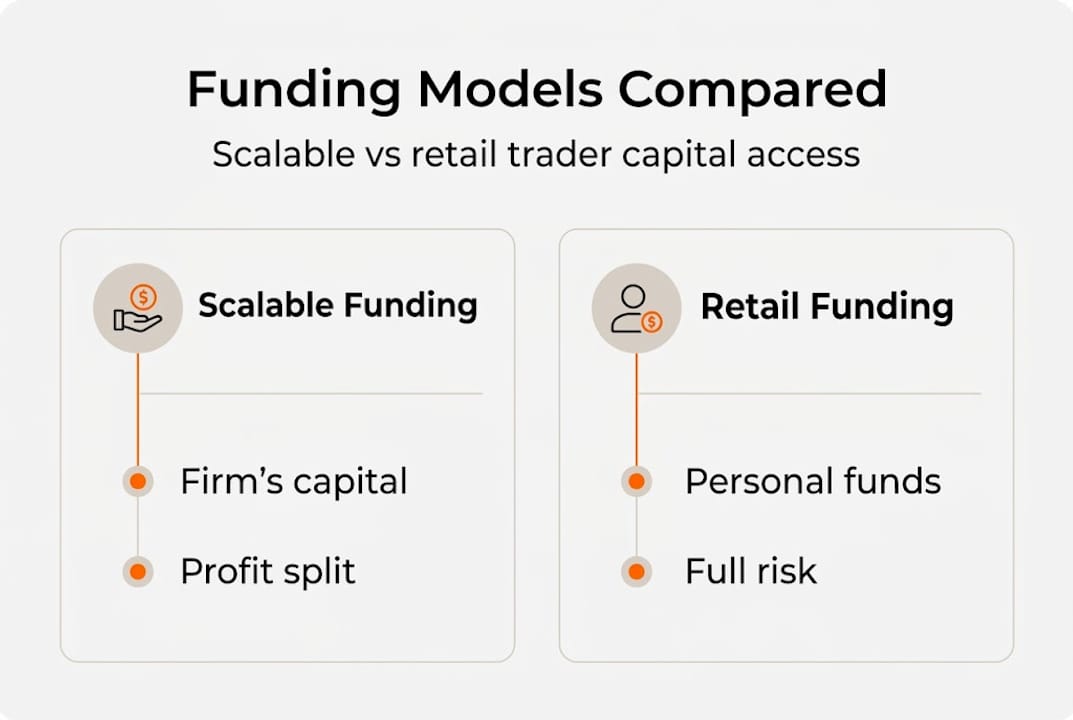
| Feature | Scalable funding (prop firm) | Traditional retail funding |
|---|---|---|
| Capital source | Firm’s capital or fee pool | Trader’s personal savings |
| Personal financial risk | Low (limited to challenge fee) | High (full personal capital at risk) |
| Profit split | 75 to 90 percent for trader | 100 percent for trader |
| Account size potential | $10,000 to $2,000,000+ | Limited by personal savings |
| Evaluation required | Yes (challenge phases) | No |
| Scaling mechanism | Performance-based milestones | Manual deposit increases |
Reviewing a detailed funding model comparison is one of the most effective ways to determine which structure aligns with your goals and trading approach before paying any fees.
Pro Tip: Before enrolling in any scalable funding program, read the full terms around scaling rules, payout frequency, and what triggers an account reset. Many programs have nuanced conditions that significantly affect your ability to withdraw profits.
Benefits and risks of scalable funding
With the mechanics clear, the next step is an honest assessment of what scalable funding delivers and where it falls short. The benefits are real, but so are the risks.
Key benefits:
- Capital access without personal exposure: Traders can operate at institutional position sizes without tying up personal savings.
- Performance-based progression: Account sizes scale in proportion to demonstrated skill, rewarding consistency over time.
- Risk-controlled environment: Defined drawdown limits force traders to practice disciplined risk management, which often improves long-term performance.
- No debt obligation: Unlike borrowing to trade, challenge fees are one-time costs. There is no ongoing debt if the account is lost.
- Professional structure: Evaluation environments simulate real trading conditions, preparing traders for managing larger capital responsibly.
Key risks:
- High failure rates: A large majority of traders do not pass the evaluation phases on the first attempt, meaning repeated fees add up quickly.
- Strict rule sets: Violating a drawdown limit by even a fraction of a percent can result in immediate account termination with no refund.
- Fee pool payouts: In many programs, strict rules and low success rates mean that payouts to successful traders are often funded by the fees collected from those who fail, not from actual live market profits.
- Simulated vs. live conditions: Some programs run challenge phases on simulated accounts, meaning slippage, liquidity, and execution conditions may differ in the funded stage.
- Psychological pressure: Trading with strict profit targets and drawdown limits creates pressure that does not exist in personal trading, leading some traders to deviate from proven strategies.
| Metric | Typical range |
|---|---|
| Challenge fee (per attempt) | $100 to $500 |
| Profit target (Phase 1) | 8 to 10 percent |
| Maximum drawdown limit | 5 to 10 percent |
| Profit split for trader | 75 to 90 percent |
| Estimated pass rate | 5 to 15 percent of attempts |
Understanding the retail funding challenges that come with these programs is just as important as understanding their appeal. Traders who enter without fully accounting for the failure rate and strict rules often find themselves spending far more on challenge fees than they ever recover in payouts.
The statistic worth internalizing: only a small fraction of traders who start an evaluation challenge successfully secure and maintain a real-money funded account. That number drops further when you factor in traders who pass but later breach rules on the funded account itself. For context on building capital the right way, reviewing strategies around avoiding trading failure provides a useful framework alongside the evaluation process.

How to maximize your impact with scalable funding
Knowing the risks and rewards puts you in a position to approach scalable funding strategically. The traders who succeed consistently are not necessarily the ones with the best raw trading skills. They are the ones who treat the evaluation process as a professional exercise in discipline and rule adherence.
Here are proven methods to increase your probability of success:
- Treat the challenge as a real funded account from day one. Traders who enter the evaluation phase thinking they can take extra risk because “it’s just a challenge” tend to breach drawdown limits early. Trade as if the capital is already real.
- Size positions conservatively relative to the drawdown limit. If your maximum drawdown is 5 percent, risking 2 percent per trade means three consecutive losses could end your challenge. Keep per-trade risk at 0.5 to 1 percent to maintain buffer room.
- Follow a strategy that you have already backtested and traded live. The evaluation is not the time to experiment with new setups. Use what you know works and execute it with precision.
- Track your progress against the profit target daily. Know exactly where you stand relative to both the profit target and the drawdown limit at all times. This prevents the panic-trading behavior that causes most failures.
- Avoid trading around high-impact news events unless your strategy specifically accounts for them. Many prop firms have rules around news trading, and unexpected volatility during these windows is a common cause of drawdown breaches.
- Take the required minimum trading days seriously. Rushing to hit a profit target in three days increases your risk-per-trade significantly. Spreading performance across the required number of days leads to more consistent results.
Strict rules cause most traders to fail at scalable funding, with payouts often not reflecting true trading profits. This reinforces the importance of approaching each challenge phase with the same discipline you would apply to managing a real institutional account.
Useful resources on account scaling tips and trading account growth strategies offer additional frameworks for traders who want to build consistency before committing to a funded evaluation.
Top mistakes to avoid:
- Increasing position size after a string of wins to hit the profit target faster
- Trading instruments you are not familiar with because they seem more volatile
- Ignoring the daily drawdown limit in favor of focusing only on the overall limit
- Failing to log trades and review performance patterns throughout the challenge
- Switching strategies midway through the evaluation after a few losing trades
Pro Tip: Long-term consistency is your most valuable asset in scalable funding. Firms are looking for traders who can produce steady, repeatable results, not those who spike profits in one session and lose them in the next. Build your evaluation strategy around controlled performance, not speed.
A unique perspective: the uncomfortable truth about scalable funding
Scalable funding is often marketed as a breakthrough opportunity for retail traders, and in some respects, it genuinely is. But the marketing frequently glosses over a fundamental reality: these programs are structured businesses, and the economics depend on more traders failing than succeeding.
Challenge fees are the revenue engine for most prop firms. When you pay $299 to attempt a $100,000 challenge, that fee does not sit in a vault waiting to fund your future profits. It covers operational costs, compensates for simulated losses, and in many cases funds payouts to the small percentage of traders who do succeed. The firm’s financial model works precisely because the pass rate is low.
This does not mean scalable funding has no value for disciplined traders. It means you need to enter with clear eyes. The traders who benefit most are those who have already proven their edge in live markets, who treat every rule as non-negotiable, and who view the challenge fee as a business cost rather than a lottery ticket.
The traders who treat scalable funding as a shortcut almost always pay more in repeat challenge fees than they ever earn in payouts. The traders who treat it as a structured performance evaluation find it genuinely useful.
Structured trading for discipline is not just a concept. It is the defining factor that separates traders who extract real value from scalable funding from those who cycle through failed challenges indefinitely.
Explore funding solutions tailored for traders
Armed with a clear understanding of scalable funding mechanics, benefits, and risks, the next step is finding a platform that supports your development as a disciplined trader.
DayProp provides structured resources to help traders at every stage of the evaluation process. Whether you are comparing program structures or looking for step-by-step guidance on how evaluations work, the platform offers transparent, practical information. You can compare funding models to identify which structure matches your trading style, or review the detailed prop funding evaluation guide for a clear picture of what the process involves from start to payout. DayProp is built to support traders who prioritize consistency and discipline over short-term speculation.
Frequently asked questions
How does scalable funding protect my personal capital?
Scalable funding allows you to trade with firm capital so you do not risk your own savings, but you must pay challenge fees and follow strict rules to qualify. Your personal financial exposure is limited to the initial challenge fee, not the full account size.
What are the fees involved in scalable funding programs?
Most scalable funding programs charge challenge fees from $100 to $500 per attempt, depending on the account size selected. These fees cover operational costs and fund losses incurred during simulated evaluation phases.
What is the success rate for traders in scalable funding challenges?
Only a tiny percentage of traders successfully secure real-money accounts after completing all challenge phases. Most traders either breach drawdown limits or fail to hit profit targets within the required timeframe.
Do payouts from scalable funding always reflect real profits?
Payouts often come from fee pools paid by other traders who failed the evaluation, not necessarily from actual live market trading profits generated by your account. This is an important distinction when evaluating the legitimacy and sustainability of any program.
Recommended
- Grow Trading Capital: 70% Avoid Failure with 2-5% Returns – DayProp Funding
- Trading account scaling tips for consistent growth in 2026 – DayProp Funding
- Compare trader funding models to find your best fit 2026 – DayProp Funding
- Structured trading challenge: Step-by-step guide to funding – DayProp Funding