TL;DR:
- Most traders feel confident after simulation but often underperform live due to emotional and execution differences. Simulated trading offers risk-free practice that lacks real slippage, liquidity issues, and emotional impact present in live markets. Bridging the gap requires realistic adjustments, disciplined review, and gradual exposure to live trading conditions.
Over 70% of simulator users report improved confidence after paper trading, yet many still face real disappointment when switching to live markets. Simulated trading lets you practice with virtual funds under real market conditions, without putting actual capital at risk. It sounds like the perfect bridge, and in many ways it is. But a gap exists between simulator performance and live execution that catches even disciplined traders off guard. This article covers exactly how simulated trading works, what the platforms offer, where they fall short, and the practical steps you can take to make simulation count when real funding is on the line.
Table of Contents
- Simulated trading explained: What it is and why it matters
- How simulated trading platforms work: Inside the mechanics
- The realism gap: Sim vs live trading (pitfalls, edge cases, and adjustments)
- Practical strategies: Closing the gap for real trading success
- The uncomfortable truth: What most traders ignore about simulated trading
- Ready to level up? Apply your skills with real funding opportunities
- Frequently asked questions
Key Takeaways
| Point | Details |
|---|---|
| Simulated trading is risk-free | You can practice strategies in real market conditions without risking real money. |
| Results differ from live trading | Simulated results often overperform by 15-30% due to missing slippage, fees, and emotion-driven mistakes. |
| Bridging the gap is essential | Making your practice more realistic prepares you better for real or funded trading challenges. |
| Prop firms value simulation | Structured evaluation and strategy benchmarking rely heavily on robust simulated trading performance. |
Simulated trading explained: What it is and why it matters
Simulated trading is, at its core, a risk-free practice method using virtual funds that mimics real market conditions. You place trades, track profits and losses, and develop a trading process without risking a single dollar of real capital. You may also see it referred to as paper trading or virtual trading, terms that mean essentially the same thing across the industry.
The concept goes back decades. Early paper traders literally wrote down hypothetical trade entries and exits on paper to test their ideas before committing real money. Modern platforms have replaced pencils with powerful software, but the core purpose remains unchanged: learn the craft without the financial consequences of mistakes.
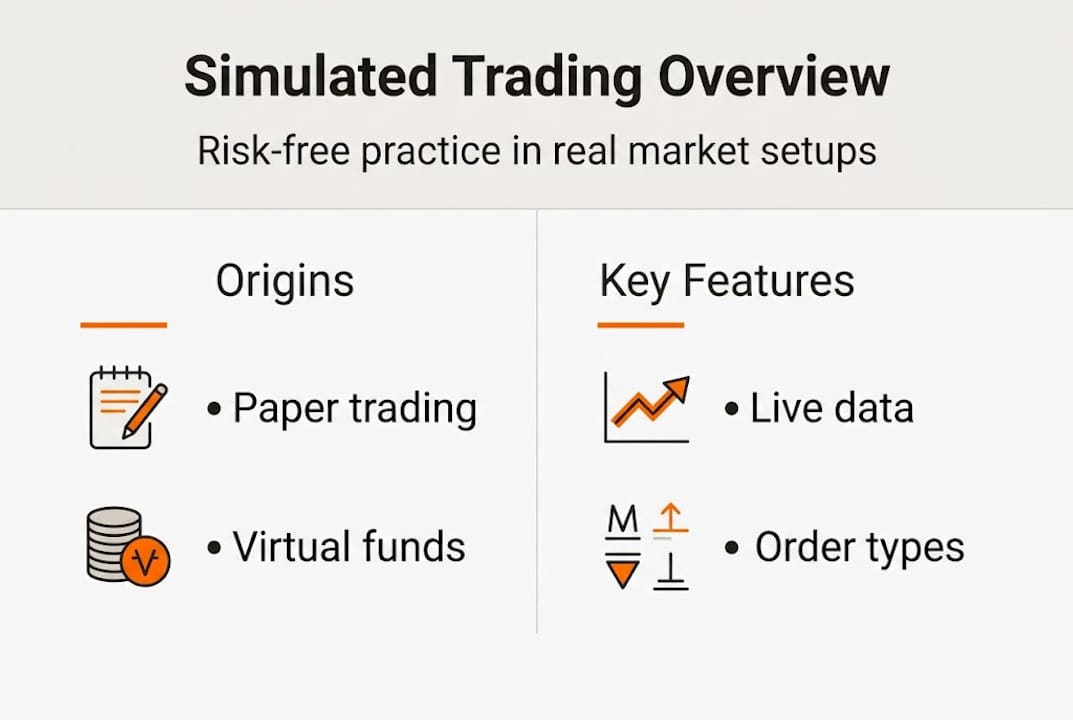
Simulators serve a wide range of traders. Beginners use them to get comfortable with price action and platform mechanics. Experienced traders use them to test new strategies without disrupting live performance. Aspiring funded traders use them specifically to prepare for prop firm evaluations in FX, indices, and crypto markets. Understanding how to build skills and avoid mistakes in simulators is what separates traders who pass evaluations from those who repeat them.
Here are the most common reasons traders turn to simulators:
- Platform familiarity: Learn order types, charting tools, and execution workflows without financial pressure.
- Strategy testing: Validate whether a trading system actually has edge before risking capital.
- Confidence building: Accumulate screen time and repetition across different market conditions.
- Evaluation preparation: Practice within prop firm drawdown rules and profit targets before the real challenge begins.
- Error analysis: Identify weaknesses in your decision process without paying tuition to the market.
“Over 70% of simulator users report improved confidence in their strategies before going live, yet performance gaps persist because simulation removes the psychological cost of real loss.”
That psychological factor is the variable most traders underweight, and it will come up again as we go deeper.
How simulated trading platforms work: Inside the mechanics
With the basics in mind, let’s look under the hood. What do simulated trading platforms actually do, and how do you use them day to day?
Platforms provide virtual capital, real-time market data, and the ability to simulate a full range of order types across FX pairs, major indices, and crypto assets. Most platforms offer a starting virtual balance anywhere from $10,000 to $100,000, allowing you to practice at account sizes that reflect real prop firm funding levels.
Here is a comparison of typical versus advanced simulator features:
| Feature | Typical simulator | Advanced simulator |
|---|---|---|
| Virtual balance | $10,000 | $10,000 to $100,000 |
| Market data | Delayed (15-20 min) | Real-time live feed |
| Slippage modeling | None | Configurable |
| Backtesting | No | Yes, with market replay |
| P&L tracking | Basic | Detailed journal reports |
| Supported markets | Stocks only | FX, indices, crypto |
Advanced platforms also include backtesting and market replay tools. Backtesting lets you run your strategy against historical price data. Market replay lets you re-experience specific sessions in real time, so you can practice reacting to news events, breakouts, or high-volatility opens without waiting for them to happen live.
Here is a step-by-step process for getting the most from a simulator:
- Sign up and configure your account. Set your virtual balance to match the prop firm challenge level you are targeting.
- Define your strategy parameters. Write down your entry rules, stop loss levels, and profit targets before you place any trades.
- Execute trades using real order types. Practice market orders, limit orders, and stop entries rather than clicking randomly.
- Record every trade in a journal. Note the rationale, market context, and outcome for each position.
- Review weekly performance. Identify patterns in your wins and losses, and adjust your approach based on data.
- Test your strategy across different market conditions. Practice in trending, ranging, and volatile environments.
Pro Tip: Use simulators with live data feeds and configurable slippage. Avoid demo platforms that lack real spreads or fill simulation. They produce results that simply do not translate to proprietary trading models or live accounts. Understanding indices strategy steps alongside platform mechanics will sharpen both your execution and your analytical edge.
The realism gap: Sim vs live trading (pitfalls, edge cases, and adjustments)
Once you know how the platforms work, it is crucial to understand where simulation ends and reality begins.
The most significant problem with simulators is that perfect fills, no slippage, and unlimited liquidity create performance expectations that simply do not hold up in live markets. In simulation, your order fills exactly where you clicked. In live markets, especially during news events or low-liquidity windows, that is rarely the case.
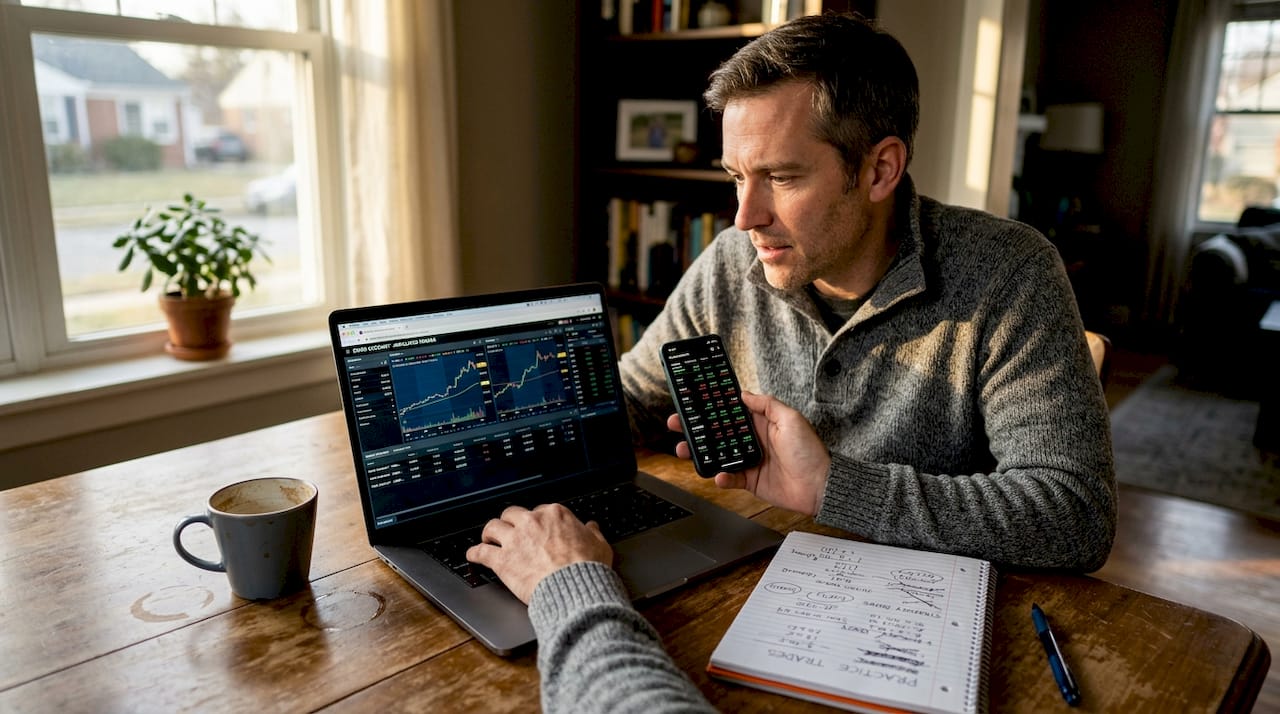
Here is a comparison of how trades execute in simulation versus live conditions:
| Execution variable | Simulator | Live market |
|---|---|---|
| Order fill | Instant at chart price | Subject to slippage and latency |
| Spread | Fixed or minimal | Variable, widens during volatility |
| Liquidity | Unlimited | Depth-dependent, especially in crypto |
| Commissions | Often zero | Real broker fees apply |
| Partial fills | Rare | Common on large orders |
Key gaps that traders consistently underestimate:
- Slippage: In volatile conditions, slippage can reach 0.5 to 2%, meaning your entry or exit lands well away from your intended price.
- Latency: Real execution speed depends on your broker, connection quality, and platform infrastructure.
- Emotional impact: Watching a real position move against you triggers stress responses that sim trading simply cannot replicate.
- Overleveraging habits: Sim traders often take position sizes they would never hold with real capital on the line.
- News-driven gaps: Crypto and FX markets can gap significantly on macro events, bypassing stop loss levels entirely.
Edge case worth noting: synthetic indices offered by some brokers run 24/7 with no news impact. They are useful for practicing execution and discipline, but they do not reflect how real FX or crypto markets behave during major economic releases. Using them exclusively can create blind spots. Understanding the full prop trading landscape will help you contextualize where simulation fits and where it does not.
Pro Tip: Manually subtract a 0.5% slippage estimate from your simulated entries and exits. Log it alongside your actual sim results. This creates a more accurate picture of what a strategy might return in a live funding evaluation.
Practical strategies: Closing the gap for real trading success
Bridging the gap is not just about knowledge. It requires concrete steps that prepare you for real capital and live market challenges.
The most effective methods for increasing sim realism include:
- Apply simulated slippage manually to every entry and exit, especially on volatile instruments.
- Document your strategy logic in writing before each session, not after.
- Practice position sizing discipline using the exact lot sizes you plan to use in your funded account.
- Review trades at your emotional worst. Deliberately replay sessions where you made mistakes under pressure.
- Set strict session rules around maximum daily drawdown, and honor them even in simulation.
Numbered transition guide from sim to live trading:
- Run at least 60 consecutive sim sessions with a consistent win rate and drawdown control before considering any funded challenge.
- Begin mixing in small live micro-lot trades alongside your simulator sessions to introduce real emotional exposure.
- Track both sets of results side by side to identify where your live behavior diverges from your sim behavior.
- Gradually shift your primary practice account to live as your behavioral consistency improves.
- Enter a structured evaluation process only once your live metrics closely match your sim metrics.
“Prop firms analyze millions of simulated trades for strategy benchmarks. Treating sim trading seriously is not optional if the goal is funded performance.”
One trap that consistently derails aspiring funded traders is chasing unrealistic sim results. Extreme sim gains signal untested risks, and prop firms enforce drawdown rules precisely because outsized returns in simulation rarely survive contact with live market conditions. Reviewing prop trading drawdown guidance alongside your simulator sessions will frame your results within realistic funded account expectations.
The uncomfortable truth: What most traders ignore about simulated trading
Having laid out strategies for bridging the gap, here is a frank assessment of what most trading guides avoid saying directly.
Most traders exit simulation feeling ready. The confidence numbers support this. But confidence built on simulated wins is fragile because it is built without the emotional cost of actual loss. When real money is at stake, decision quality drops. Traders second-guess levels they would have held without hesitation in sim. They exit early, widen stops, or freeze entirely. None of those behaviors show up in simulator metrics.
The biggest overlooked factor is not slippage or spreads. It is emotional volatility in live conditions. Prop firm data consistently shows that traders who outperform in simulation by 15 to 30% tend to underperform in the first weeks of live or funded trading. That gap does not close by running more sim sessions. It closes by deliberately engineering stress into your practice, reviewing failure honestly, and applying simulator performance insights with the same rigor you bring to technical analysis.
Simulation is a tool. Its value depends entirely on how seriously you treat it.
Ready to level up? Apply your skills with real funding opportunities
Simulated trading is a foundational step, but at some point your edge needs to be tested against real evaluation criteria and real market conditions.
DayProp provides the structured environment to make that transition. From understanding how to secure prop funding to reviewing detailed guides on how to compare trader funding models, the platform is built for traders who are serious about moving from practice to performance. If you are ready to apply your simulator skills in a structured challenge with clear rules and transparent payout models, review the step-by-step evaluation process and find out where your trading stands.
Frequently asked questions
Is simulated trading the same as real trading?
No. Simulated trading mimics real markets but cannot fully recreate psychological pressure or live execution conditions, since simulators lack real slippage, latency, and emotional stress.
What’s the typical starting balance in a trading simulator?
Most simulators start users with a $10,000 to $100,000 virtual balance to practice trading across different market conditions.
Why do results differ between simulated and live trading?
Live trading involves slippage, commissions, partial fills, and emotional pressure, which is why simulated strategies typically outperform live results by 15 to 30%.
How can I make simulated trading more realistic?
Manually account for slippage and fees on each trade, maintain a detailed trading journal, and treat simulation sessions with the same discipline as a live account, as adding slippage and journaling are the most effective realism adjustments.
Can I use simulated trading to prepare for prop firm funding?
Yes. Prop firms evaluate traders based on consistent risk management and strategy discipline, and they analyze millions of sim trades to establish performance benchmarks.
Recommended
- Why use trading simulators: skills, strategy, fewer mistakes – DayProp Funding
- What Is Real Trading Skill? 60% Less Risk, 25% Higher Returns – DayProp Funding
- Trader skill vs luck: What really drives trading success – DayProp Funding
- Understand real trading conditions: trade like a pro – DayProp Funding