

Every experienced trader knows a cluttered desk or lagging connection can cost more than just focus during a critical session. For those aiming to secure evaluation funding, the right setup goes far beyond hardware. Creating a professional trading environment with reliable tech, ergonomic design, and distraction control supports the consistent discipline required by top prop firms. This guide breaks down actionable steps to help you build the foundation that maximizes your readiness for funding success.
Table of Contents
- Step 1: Set Up Your Trading Environment
- Step 2: Review Evaluation Rules and Criteria
- Step 3: Implement Trading Strategies with Discipline
- Step 4: Track Performance and Adhere to Risk Limits
- Step 5: Verify Results for Funding Approval
Quick Summary
| Essential Insight | Clarification |
|---|---|
| 1. Set Up a Reliable Trading Environment | Use a powerful computer and wired internet for better performance and minimal distractions. |
| 2. Understand Prop Trading Evaluation Rules | Thoroughly review rules on profit targets and drawdown limits to prevent disqualification. |
| 3. Document Your Trading Plan | Write down entry and exit strategies to ensure you follow your rules and maintain discipline. |
| 4. Track Performance Closely | Create a trade journal to monitor adherence to risk limits and improve decision-making. |
| 5. Prepare for Funding Approval | Compile trading records showing compliance to all evaluation criteria for a smooth review process. |
Step 1: Set Up Your Trading Environment
Your trading environment directly impacts your decision-making quality and consistency. A proper setup reduces distractions, speeds up execution, and supports the discipline required to succeed in prop trading evaluations.
Start by building the technical foundation. You’ll need a reliable computer capable of running multiple applications simultaneously without lag. Most active traders benefit from a system with solid processing power and at least 16GB of RAM. Your internet connection is equally critical—a wired connection with low latency is superior to wireless, and you should have a backup internet option ready in case your primary connection fails.

Pro tip: A secondary mobile hotspot or second broadband line costs minimal money but prevents a connection dropout from derailing your entire evaluation attempt.
Multiple monitors make a significant difference in your workflow. Here’s what traders typically use:
- Primary monitor for your main trading platform and charts
- Secondary monitor for economic calendars, news feeds, and analysis tools
- Tertiary monitor (optional) for communications or additional data
Physical ergonomics matter more than traders realize. Position your monitors at eye level about an arm’s length away. Your chair should support your back properly during long trading sessions. Poor posture creates fatigue, which directly impacts judgment calls during volatile market conditions.
Optimize your workspace environment itself. Proper lighting reduces eye strain during extended screen time. Position your desk away from direct sunlight to avoid glare on your monitors. Control noise levels—whether through noise-canceling headphones or a quiet room—because unnecessary audio distractions fragment your focus. Keep your desk organized and clutter-free; research shows that visual chaos in your workspace increases cognitive load.
Here’s a quick comparison of common workspace distractions and effective solutions for traders:
| Distraction Source | Impact on Trading Focus | Effective Mitigation Strategy |
|---|---|---|
| Noisy environment | Breaks concentration | Use noise-canceling headphones |
| Screen glare | Causes eye fatigue | Adjust monitor position, use blinds |
| Poor ergonomics | Leads to physical discomfort | Invest in ergonomic chair and desk |
| Desk clutter | Increases cognitive load | Keep workspace organized daily |
Your platform selection matters strategically too. Risk management in prop trading requires clean, intuitive order execution. You’ll spend hours analyzing charts and placing trades, so choose platforms that feel natural to your workflow. Test your platform thoroughly before your evaluation begins.
Document your setup once it’s complete. Take screenshots of your monitor arrangement, platform settings, and toolbar configurations. This creates a reference point if you need to troubleshoot issues during your evaluation. It also helps you replicate this exact environment consistently, which supports better habit formation and performance tracking.
Step 2: Review Evaluation Rules and Criteria
Understanding the evaluation rules before you start is non-negotiable. These rules define what success looks like, what mistakes disqualify you, and how your account will be assessed. Skipping this step means trading blind.
Start by reading through all documentation provided by your prop firm. Most firms publish detailed rules covering account requirements, profit targets, and drawdown limits. You need to know these numbers precisely, not approximately. A 5% maximum daily loss means something very different than a 10% limit, and misunderstanding this detail could end your evaluation before you gain momentum.
Key areas to focus on include:
- Profit targets and the timeframe for achieving them
- Maximum drawdown limits (daily and overall)
- Minimum trade duration requirements if applicable
- Prohibited trading strategies or restricted instruments
- Payout timelines and fund withdrawal procedures
Write down these rules in a document you can reference quickly. Create a checklist of do’s and don’ts specific to your evaluation. Some firms prohibit scalping under 5 seconds, others restrict news trading within 10 minutes of major economic releases. Others have specific position sizing rules tied to your account size. These constraints shape your entire trading approach.
Review the performance-based trading evaluation process to understand how your trades will actually be assessed. Different evaluation models reward different behaviors. Some firms prioritize consistency over peak profit, while others focus on risk-adjusted returns. Knowing which metrics matter most helps you prioritize your trading decisions during the evaluation.
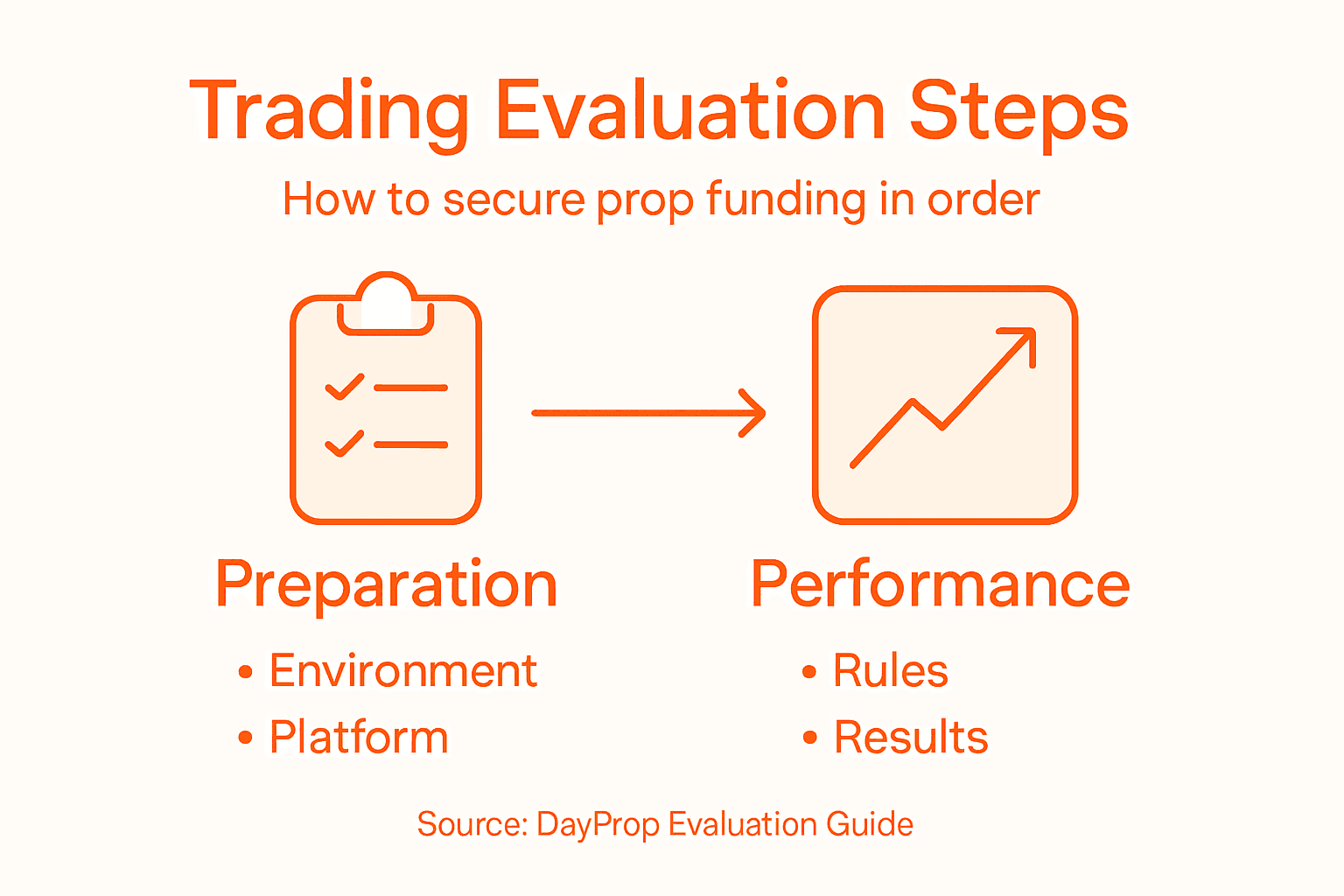
Pay special attention to any restart policies or challenge levels. Some evaluations allow one failed attempt before you must repay, while others provide multiple chances. Understanding what happens if you hit a drawdown limit prevents panic during difficult trading periods.
Create a simple one-page reference sheet with the most critical rules. Post it near your trading desk so you never forget a restriction in the heat of trading. This prevents careless violations that could result in disqualification despite solid trading logic.
Below is a summary table of key evaluation criteria and why each matters during a prop trading assessment:
| Criteria | Why It Matters | Common Pitfall to Avoid |
|---|---|---|
| Profit Target | Measures trading skill and edge | Chasing profits, risking too much |
| Daily Loss Limit | Protects account from major setbacks | Ignoring stop-losses |
| Minimum Trade Duration | Ensures genuine trading activity | Closing trades prematurely |
| Strategy Restrictions | Maintains fair evaluation environment | Using banned approaches |
| Drawdown Limit | Demonstrates discipline in risk | Exceeding allowed drawdown |
Pro tip: Contact your prop firm’s support team before your evaluation starts to clarify any ambiguous rules—confusion during trading costs real money and evaluation progress.
Step 3: Implement Trading Strategies with Discipline
A solid trading strategy means nothing if you cannot execute it consistently. Discipline separates traders who occasionally profit from traders who build sustainable accounts. This step transforms your strategy from theory into measurable, repeatable action.
Start by documenting your complete trading plan in writing. Define your entry signals, exit rules, position sizes, and risk parameters for each trade. Your plan should specify when you trade, what you trade, and how much you risk per position. Vague plans lead to vague execution, which leads to emotional decisions during volatile markets.
Managing fear and greed requires more than willpower alone. You need systems that remove discretion from critical moments. Set your stop losses before entering trades, not after. Calculate your position size based on risk percentage before you see the entry price. This removes the temptation to overtrade when you feel confident.
Build accountability into your routine with these practices:
- Journal every trade with entry logic, exit reason, and outcome
- Track your adherence to rules, not just profit and loss
- Review weekly to identify patterns in rule violations
- Rate your discipline separately from trading results
Emotional control matters during drawdowns and winning streaks alike. A 5-trade losing streak feels different at the start of your evaluation versus week two. Both scenarios demand identical rule adherence. When you feel frustrated or overconfident, that is precisely when your written rules protect you.
Consistency builds long-term profitability through systematic execution. Each trade follows the same process: plan, execute, record, review. This repetition trains your brain to respond to market conditions with predetermined actions rather than emotional reactions. Over 50 trades, this discipline compounds into measurable edge.
Set daily and weekly checkpoints. Before market open, review your game plan. After market close, journal your trades. On weekends, assess whether you followed your strategy. Did you skip trades your plan identified? Did you take trades outside your rules? This honest reflection reveals where discipline breaks down.
Discipline is not about being perfect. It is about following your plan more often than you break it, especially when breaking it feels justified.
Pro tip: Use a simple checklist before every trade: rules check, position sizing confirmation, and stop-loss placement—three seconds of verification prevents 99 percent of discipline failures.
Step 4: Track Performance and Adhere to Risk Limits
Tracking your performance is not optional in prop trading. Your ability to access capital depends entirely on demonstrating that you can follow risk rules consistently. This step builds the accountability system that keeps you profitable and prevents early account termination.
Start by setting up a simple spreadsheet or trading journal to record every trade. Include entry date, entry price, exit price, profit or loss, and most importantly, whether the trade followed your rules. The profit amount matters less than your adherence to predetermined parameters. A losing trade taken according to plan demonstrates discipline. A winning trade outside your rules reveals a dangerous pattern.
Effective risk management requires tracking three critical limits simultaneously. Your daily loss limit, your maximum drawdown from account peak, and your per-trade risk percentage all demand constant monitoring. Most traders fail because they break one limit thinking they can compensate later. Prop firms have zero tolerance for this approach.
Implement these tracking essentials:
- Daily P&L monitor showing current loss relative to your limit
- Drawdown calculator tracking total loss from your highest account balance
- Risk per trade record confirming you stayed within your percentage
- Rule adherence percentage measured separately from profitability
Set alerts for when you reach 50 percent of your daily loss limit. Most traders wait until 75 percent to reassess, which leaves almost no margin for error. Early warnings give you time to pause, reset mentally, and make conscious decisions rather than reactive ones.
Journal your emotions alongside your trades. Note when you felt overconfident, frustrated, or desperate. These emotional states correlate directly to rule violations. Over time, you will recognize the emotional patterns that precede your mistakes. Self-awareness becomes your earliest warning system.
Review your complete performance weekly, not daily. Daily reviews create emotional noise. Weekly reviews reveal patterns. Did you lose money consistently on news events? Did you overtrade after winning days? These patterns inform whether your rules need adjustment or your execution needs improvement.
The traders who pass evaluations are not always the most profitable. They are the ones who consistently follow their risk limits, which eventually creates profitability through compound consistency.
Pro tip: Set your risk limit alerts at 50 percent and stop trading for the day at 75 percent—this two-tier approach prevents catastrophic days while protecting your evaluation account from premature termination.
Step 5: Verify Results for Funding Approval
You have executed your trades, followed your rules, and tracked your performance meticulously. Now comes the critical phase where your results are reviewed and evaluated for funding approval. This step ensures your account meets all criteria and positions you for capital access.
Begin by compiling your complete trading record. Gather all trade confirmations, statements, and performance documentation from your trading platform. Your prop firm will verify that your results are authentic and comply with their evaluation criteria. Transparency at this stage prevents delays and eliminates questions during the approval process.
Understanding how the performance-based trading evaluation process works helps you anticipate what reviewers examine. They verify your profit targets were achieved, your drawdown limits were respected, and your trading activity shows legitimate edge rather than luck. Reviewers also examine your trade frequency and win rate to assess consistency.
Prepare documentation with these components:
- Complete trade journal with entry and exit details for every position
- Performance summary showing cumulative profit, drawdown levels, and win rate
- Risk compliance record demonstrating adherence to daily and maximum loss limits
- Trading statistics including average win, average loss, and profit factor
Double-check your numbers before submission. Calculation errors or missing trades create red flags that delay approval. Reviewers expect precise documentation from disciplined traders. Sloppy record-keeping contradicts the discipline narrative you built during your evaluation.
Contact your prop firm if you have questions about what constitutes passing results. Different firms have different standards. Some require 10 percent profit in 30 days. Others measure over longer periods or use different metrics. Clarifying expectations prevents the disappointment of missing unstated targets.
After submission, your firm typically reviews results within 5 to 10 business days. They verify your trading activity against their records and confirm no rule violations occurred. Some firms request additional documentation or clarification during this review. Respond promptly to any requests to accelerate your approval timeline.
Your evaluation results represent more than profit. They demonstrate you can execute a plan consistently, manage risk systematically, and trade with discipline. Reviewers are funding your ability to do these things repeatedly.
Pro tip: Create a final summary document highlighting your key metrics: profit achieved, maximum drawdown, win rate, and average risk-to-reward ratio—this one-page overview helps reviewers quickly confirm you meet approval criteria.
Take Control of Your Prop Trading Evaluation with DayProp
Navigating the complexities of a trading evaluation requires more than just skill. It demands strict discipline, clear risk management, and unwavering adherence to rules—exactly the challenges outlined in the Trading Evaluation Guide for Securing Prop Funding. If you are seeking a structured environment that holds you accountable while offering real funding opportunities, DayProp offers a professional solution tailored to your needs. Our platform emphasizes transparent evaluation criteria, realistic market conditions, and performance-based growth to help you overcome common obstacles like drawdown limits and inconsistent execution.
Experience how DayProp’s proprietary trading challenges and clear risk parameters reward true trading skill over speculation. Start building your funded trading career today by exploring our Uncategorized – DayProp Funding resources and learn how to turn your trading discipline into capital through DayProp’s platform. Don’t wait until confusion or overlooked rules cost you an evaluation—take action now and position yourself for consistent success.
Frequently Asked Questions
What is the first step to prepare for a prop trading evaluation?
To prepare for a prop trading evaluation, the first step is to set up your trading environment. Make sure you have a reliable computer, a low-latency internet connection, and possibly multiple monitors to optimize your workflow.
How do I effectively track my trading performance during the evaluation?
To track your trading performance effectively, maintain a detailed trading journal that includes every trade’s entry and exit details, along with whether you adhered to your trading rules. Review this journal weekly to identify trading patterns and areas for improvement.
What are key evaluation rules I should know before starting?
Before starting your trading evaluation, understand key rules such as profit targets, maximum drawdown limits, and minimum trade durations. Write down these rules and create a checklist to reference during your evaluation to avoid careless mistakes.
How can I build discipline in executing my trading strategy?
To build discipline in executing your trading strategy, document your complete trading plan with clear entry and exit rules, and set up systems to minimize discretionary decisions. Journal every trade and review your adherence to the plan regularly to enhance consistency.
What should I compile for the final funding approval?
For the final funding approval, compile a complete trading record including trade confirmations, a performance summary, and a risk compliance record. Double-check your calculations to ensure accuracy before submitting these documents, as this will expedite the approval process.
How can I manage emotions during a trading evaluation?
To manage emotions during a trading evaluation, journal your emotional state alongside your trades. Recognizing patterns in your emotional responses can help you maintain discipline and avoid rule violations during both winning and losing streaks.
Recommended