

TL;DR:
- Performance reviews focus on process quality and discipline, not just profits.
- Systematic reviews identify behavioral biases impacting long-term trading success.
- Consistent process evaluation enhances funding prospects and sustainable trading performance.
Most retail traders believe a performance review is simply a check on profits and losses. This assumption is costly. Behavioral research in retail trading shows that process quality and psychological discipline explain trader outcomes far more reliably than raw P&L numbers. For traders pursuing prop funding, this distinction is not academic. Funding evaluators assess how you trade, not just whether you profited. This guide breaks down what a structured performance review actually covers, how behavioral biases surface in the process, and how to build a repeatable review framework that improves your trading and strengthens your funding applications.
Table of Contents
- Why performance review matters in trading
- Key components of a trading performance review
- How behavioral insights and biases shape trading reviews
- Building your own trading performance review framework
- Our perspective: Why serious traders prioritize process over profits
- Take your trading reviews to the next level with DayProp
- Frequently asked questions
Key Takeaways
| Point | Details |
|---|---|
| Review is more than profits | The best trading performance reviews analyze process and psychology, not just P&L results. |
| Behavior impacts outcomes | Cognitive biases can explain up to 64% of a retail trader’s performance variance. |
| Structure drives improvement | Building a repeatable review routine helps spot and fix weaknesses before risking capital. |
| Funders value discipline | Prop firms want to see strong process and behavioral controls in your trading history. |
Why performance review matters in trading
A trading performance review is a systematic evaluation of a trader’s decisions, processes, risk management approach, and outcomes over a defined period. It is not a simple profit calculation. Done correctly, it maps the quality of your execution, the consistency of your risk controls, and whether your behavior aligned with your stated strategy.
For traders seeking capital through proprietary funding programs, this distinction carries real weight. Funders look for evidence of repeatable, disciplined behavior. A trader who consistently earns modest returns with controlled drawdowns often scores higher in evaluations than one who posts large gains through inconsistent, high-risk decisions. The performance-based evaluation guide at DayProp outlines exactly what evaluators prioritize in structured challenges.
Research confirms that trading skill is highly heterogeneous, meaning there is no single profile of a profitable trader. What successful traders share, however, is a commitment to reviewing process and behavior alongside results. This is what separates developing traders from funded professionals.
Key reasons performance reviews matter for serious traders:
- They identify whether gains came from skill or variance
- They surface behavioral patterns that erode long-term performance
- They document risk discipline, which funders require
- They create a feedback loop for continuous improvement
- They provide structured evidence of trading edge during evaluations
When reviewing trading performance metrics, focus on whether your results reflect a defined process. A single strong month does not indicate edge. Consistent adherence to risk rules across many trades does.
“A performance review that only examines profits misses the variables that actually determine whether a trader can sustain results over time.”
This is why prop firms and institutional evaluators place equal or greater emphasis on process documentation than on short-term returns. Building your review habit now creates a direct pathway to funding credibility later.
Key components of a trading performance review
A structured review covers several distinct layers. Each layer reveals a different dimension of trading quality and helps identify where adjustments are needed.
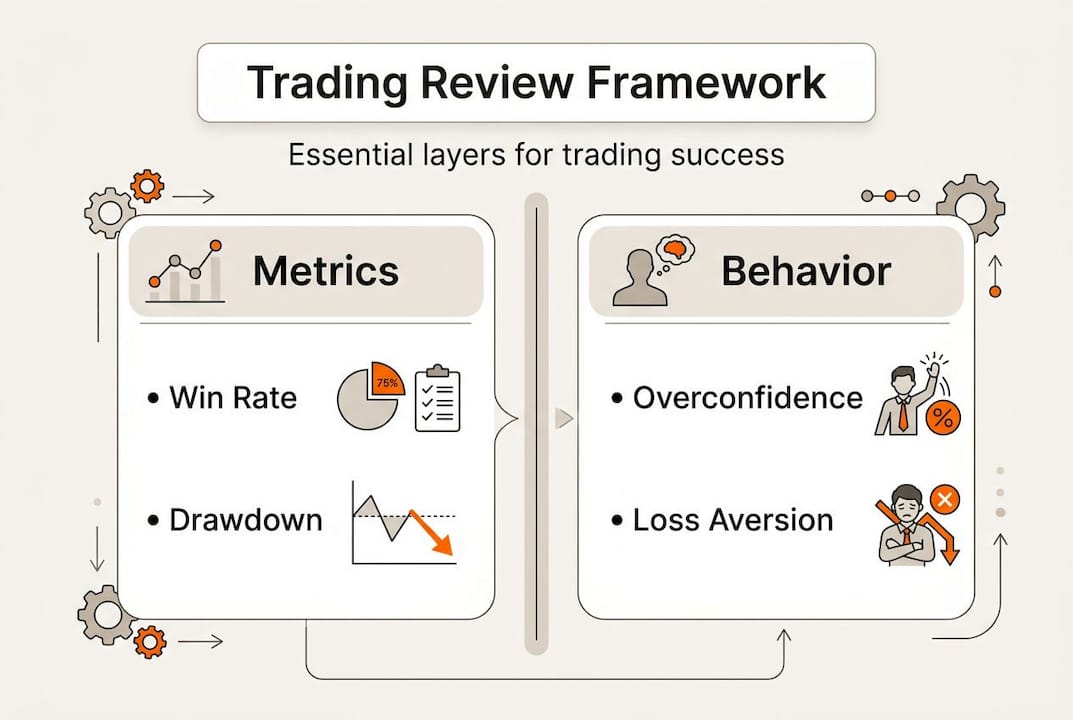
Quantitative metrics form the foundation. These include risk-adjusted returns, maximum drawdown, average risk-to-reward ratio, win rate, and trade frequency. No single metric tells the full story. A high win rate paired with poor risk-to-reward management, for example, often signals hidden account risk.
Behavioral audit identifies psychological patterns. Overtrading after losses, increasing position sizes after wins, or abandoning the trading plan during volatile sessions are all behavioral signals. Data from large-scale studies show that cognitive biases are central to explaining performance variability between traders with similar market access and capital.

Process audit examines execution quality. Did you follow your entry and exit criteria? Did you honor your stop-loss levels? Was your position sizing consistent with your risk parameters?
Pro Tip: Keep a trade log that records not just entry/exit data but also the reasoning behind each trade. This turns your journal into a behavioral audit tool, not just a record of numbers.
Here is a comparison of two traders using the same strategy over the same period:
| Review area | Trader A | Trader B |
|---|---|---|
| Win rate | 58% | 54% |
| Average risk-to-reward | 1.2:1 | 2.1:1 |
| Max drawdown | 12% | 5% |
| Overtrading incidents | 11 | 1 |
| Strategy adherence | 64% | 93% |
| Evaluation outcome | Failed | Passed |
Trader B’s results are clearly stronger despite a lower win rate. This is exactly why trading performance monitoring must go beyond win percentage. The process audit reveals that Trader A’s behavioral issues, specifically overtrading and plan abandonment, drove the drawdown and evaluation failure.
Reviewing your key trading metrics against your process records creates a much clearer picture of where performance gaps actually originate.
How behavioral insights and biases shape trading reviews
Behavioral factors are not soft variables. They are measurable, and they matter. Research finds that cognitive biases explain 43 to 64% of the variance in trading outcomes across retail trader populations. This is a significant range, and it means that for many traders, psychology is the single largest driver of performance gaps.
The three most commonly identified biases in retail trader reviews are:
Overconfidence leads traders to underestimate risk after winning streaks. Position sizes increase, stop-losses widen, and the trading plan gets abandoned in favor of intuition. The review process catches this by comparing position size variance against account equity growth.
Loss aversion causes traders to hold losing trades far longer than planned and cut profitable trades too early. The result is a skewed risk-to-reward profile that looks poor in review even when the underlying strategy has genuine edge.
Excessive risk-taking often appears after a series of small losses. Traders attempt to recover quickly by sizing up, violating their risk parameters. This is sometimes called revenge trading.
Research also shows that behavioral bias expression differs between smaller and larger retail traders. Smaller account holders tend to show more pronounced loss aversion, while larger traders more frequently display overconfidence. Knowing which category you fall into shapes how you prioritize your review.
Steps to address behavioral flaws during your review:
- Flag every trade where you deviated from the plan and document the reason
- Calculate the average loss on deviation trades versus plan-adherent trades
- Identify time-of-day or market-condition patterns that trigger emotional decisions
- Set a firm rule: if you deviate more than three times in a week, pause trading and review
- Compare your deviation rate across monthly reviews to track improvement
“Recognizing the bias is not enough. The review process must produce specific, measurable changes in behavior to have any lasting effect.”
Applying best practices for retail trading alongside a bias-aware review process gives traders a concrete path to correcting patterns that cost them capital and funding opportunities.
Building your own trading performance review framework
A performance review framework turns reflection into a repeatable system. Without structure, reviews become sporadic and lose their corrective power. The goal is consistency, not perfection.
Here is a step-by-step approach:
- Collect your data: Export trade records from your platform, including timestamps, position sizes, entry/exit prices, and P&L per trade. Raw data is the foundation of any honest review.
- Define your metrics: Choose the five to seven metrics most relevant to your strategy. For a momentum trader, average holding time and breakout success rate matter more than dividend yield or overnight carry.
- Audit your process: Compare each trade against your pre-defined trading rules. Mark adherence, partial adherence, or deviation for each trade.
- Review your biases: Using your deviation log, identify which bias appeared most often. Quantify its cost in both dollar terms and missed opportunities.
- Plan adjustments: Set one or two specific behavioral targets for the next review period. Vague goals like “trade less emotionally” are not measurable. Concrete targets like “reduce overtrading incidents from ten to four” are.
Structured process reviews help traders identify performance gaps before they result in financial loss, making pre-evaluation reviews especially important for anyone approaching a funding challenge.
Pro Tip: Conduct a brief weekly review and a deeper monthly review. Weekly reviews catch acute behavioral issues. Monthly reviews reveal systemic patterns that weekly data can obscure.
If you are new to systematic self-assessment, start with retail trading fundamentals to build the baseline knowledge that makes reviews more meaningful. Traders preparing for structured funding challenges should also study common trading challenges to align their review criteria with evaluation standards.
When applying for funding, a documented review history serves as direct evidence of discipline. Many evaluators treat a trader’s ability to self-assess and self-correct as a strong predictor of funded account performance. The trading evaluation for prop funding framework explains how to present this evidence effectively.
Our perspective: Why serious traders prioritize process over profits
Conventional trading wisdom centers on profits. Traders measure success by monthly returns and compare results in terms of percentage gains. This framing is understandable but incomplete.
From our experience working with and evaluating traders across FX, indices, and crypto, the traders who sustain funding and scale their accounts consistently share one trait: they treat process as the primary output and profit as a byproduct. They review their adherence rates, their deviation patterns, and their behavioral tendencies with the same rigor they apply to chart analysis.
Funders, including DayProp, do not simply look for a profitable month. They look for evidence that a trader can repeat their results under varying market conditions. That repeatability only comes from a structured review process. A trader who knows why they made money is far more fundable than one who simply did.
The uncomfortable truth is that many traders avoid detailed reviews because the data is unflattering. Facing your deviation rate or your bias patterns requires honesty. But that honesty is precisely what separates traders who get funded from those who do not. Prioritizing the success factors for consistent profits begins with an honest, structured review of where your current process falls short.
Take your trading reviews to the next level with DayProp
If you are serious about converting your review process into real funding opportunities, DayProp provides the frameworks and evaluation structure to make that transition concrete.
DayProp’s performance evaluation process is built around the same behavioral and process-based standards outlined in this guide. Traders who have developed a structured review habit enter DayProp challenges with a measurable advantage. They understand what evaluators look for and have documented evidence of their discipline. If you want to assess which funding structure fits your trading style, explore how to compare funding models before starting your evaluation. DayProp is designed for traders who are ready to move from self-assessment to funded performance.
Frequently asked questions
What is the main purpose of a performance review in trading?
A trading performance review systematically assesses both your process and behavioral habits, not just profits, to identify improvement areas and funding readiness. Process and behavioral reviews are as crucial as P&L analysis for any serious trader.
How often should I review my trading performance?
Most disciplined traders conduct weekly or bi-weekly reviews to spot behavioral issues early and keep their strategies on track. A deeper monthly review is also recommended to identify systemic patterns over time.
What behavioral biases affect trading performance the most?
Overconfidence, loss aversion, and excessive risk-taking are the most common biases in retail trading, and cognitive biases significantly explain variability in retail trading results across trader populations.
Can my performance review help me secure prop trading funding?
Yes. Showcasing a disciplined review process with behavioral and risk controls significantly strengthens your funding application. Evaluators value process discipline as much as profit numbers when assessing trader readiness for funded accounts.
Recommended