
Prop trading isn’t just for Wall Street anymore. Retail traders can now access firm capital via evaluation challenges, trading FX, indices, and crypto without risking personal funds. This guide breaks down how proprietary trading works for individual traders, what evaluation challenges involve, realistic success rates, and how to choose firms that actually pay out. You’ll learn the mechanics, risks, and practical steps to pursue funded trading accounts in 2026.
Table of Contents
- Understanding Prop Trading For Retail Traders
- How Evaluation Challenges Work: Rules, Targets, And Payouts
- Success Rates, Risks, And Industry Realities For Retail Prop Traders
- Choosing The Right Prop Trading Firm And Preparing To Succeed
- Explore Funded Prop Trading Opportunities With DayProp
- What Is Prop Trading? Frequently Asked Questions
Key takeaways
| Point | Details |
|---|---|
| Prop trading definition | Retail traders access firm capital after passing evaluation challenges to trade FX, indices, and crypto with 70-95% profit splits. |
| Evaluation structure | Challenges involve 1-3 steps with 5-10% profit targets, 3-5% daily loss limits, and 5-12% total drawdown caps. |
| Success rates | Industry pass rates are 5-10% on first attempt, with only 7% of traders ever receiving payouts. |
| Firm selection | Choose transparent firms with proven payout histories like FTMO or Apex, and practice rules on demo accounts first. |
| Risk management | Strict drawdown limits and firm rule violations can result in account termination or payout denial. |
Understanding prop trading for retail traders
Proprietary trading for retail traders means using a firm’s capital instead of your own money to trade financial markets. You pass an evaluation challenge that tests your trading discipline and risk management, then receive a funded account. The firm provides the capital, you execute trades, and profits are split between you and the firm.
Most prop firms focus on three main markets: foreign exchange (FX), stock indices, and cryptocurrencies. These markets offer high liquidity and volatility, creating opportunities for skilled traders to generate consistent returns. Unlike traditional trading where you risk your own savings, prop trading lets you demonstrate skill with firm money after proving yourself through structured challenges.
The profit split typically ranges from 70-95% in your favor, depending on the firm and account size. Some firms start at 80% and increase your share as you scale to larger accounts. This arrangement benefits both parties: traders access capital they couldn’t afford independently, while firms profit from successful traders without taking market risk themselves.
Key benefits of prop trading include:
- Access to substantial capital (often $10,000 to $200,000+) without personal financial risk
- Professional trading infrastructure and tools provided by the firm
- Ability to scale accounts based on consistent performance
- Learning real risk management under professional parameters
- Keeping majority of profits while trading larger positions
Pro Tip: Start with smaller account sizes during evaluations. Passing a $10,000 challenge builds confidence and understanding of firm rules before attempting larger funded accounts that require tighter risk management.
The proprietary trading model has evolved significantly since 2020, with dozens of firms now serving retail traders globally. This democratization of trading capital represents a fundamental shift in how individual traders can build careers without needing wealthy backers or institutional employment.
How evaluation challenges work: rules, targets, and payouts
Evaluation challenges test whether you can trade profitably while respecting strict risk parameters. Most firms use a multi-step process before granting funded accounts. Understanding these mechanics helps you prepare effectively and avoid costly mistakes during assessment phases.
Typical challenge structure follows these steps:
- Purchase the evaluation (fees range from $100 to $1,000+ depending on account size)
- Complete Phase 1 by hitting profit targets while staying within drawdown limits
- Pass Phase 2 with similar or reduced targets to prove consistency
- Receive funded account and begin profit-sharing arrangement
- Scale to larger accounts by maintaining performance standards
The profit targets typically range from 5-10% of the account balance, while daily loss limits sit at 3-5% and total drawdown caps at 5-12%. These parameters force disciplined position sizing and risk management. Many firms impose no time limits, allowing you to trade at your own pace without pressure to rush trades.

Payout structures vary significantly across firms. Here’s how major players compare:
| Firm Type | Profit Split | Payout Frequency | Scaling Potential |
| — | — | — |
| Standard Model | 70-80% | Monthly | Up to $200,000 |
| Premium Model | 80-90% | Bi-weekly | Up to $2,000,000 |
| Elite Model | 90-95% | Weekly | Up to $5,000,000+ |
Successful traders typically earn between $500 and $5,000 monthly from a single funded account, though top performers with scaled accounts can generate $10,000+ monthly. The key is consistency rather than home runs. Firms value traders who compound small wins while avoiding large drawdowns.
Scaling programs reward consistent performance with larger capital allocations. After demonstrating profitability for 3-6 months, many firms increase your account size by 25-100%. This progression path means a trader starting with a $25,000 account could manage $100,000+ within a year through disciplined trading.
Common firm rules include:
- No hedging between multiple accounts
- No high-frequency scalping or algorithmic trading (varies by firm)
- Must close positions by weekend or hold with adequate margin
- Cannot exceed maximum position sizes relative to account balance
- Some firms prohibit trading during major news events
Pro Tip: Read the firm’s trading rules document three times before starting your challenge. Small rule violations like exceeding position limits by 0.1 lots can invalidate an otherwise profitable evaluation, wasting your entry fee and time.
The evaluation fee structure creates the firm’s business model. Most traders fail challenges, so firms profit primarily from assessment fees rather than trader losses. This incentive structure means firms genuinely want successful traders who generate long-term profit splits, but the high failure rate ensures profitability regardless.
Success rates, risks, and industry realities for retail prop traders
The prop trading industry shows harsh statistics that every aspiring funded trader must understand. While marketing materials showcase success stories, the data reveals a challenging path that requires exceptional discipline and realistic expectations about outcomes.
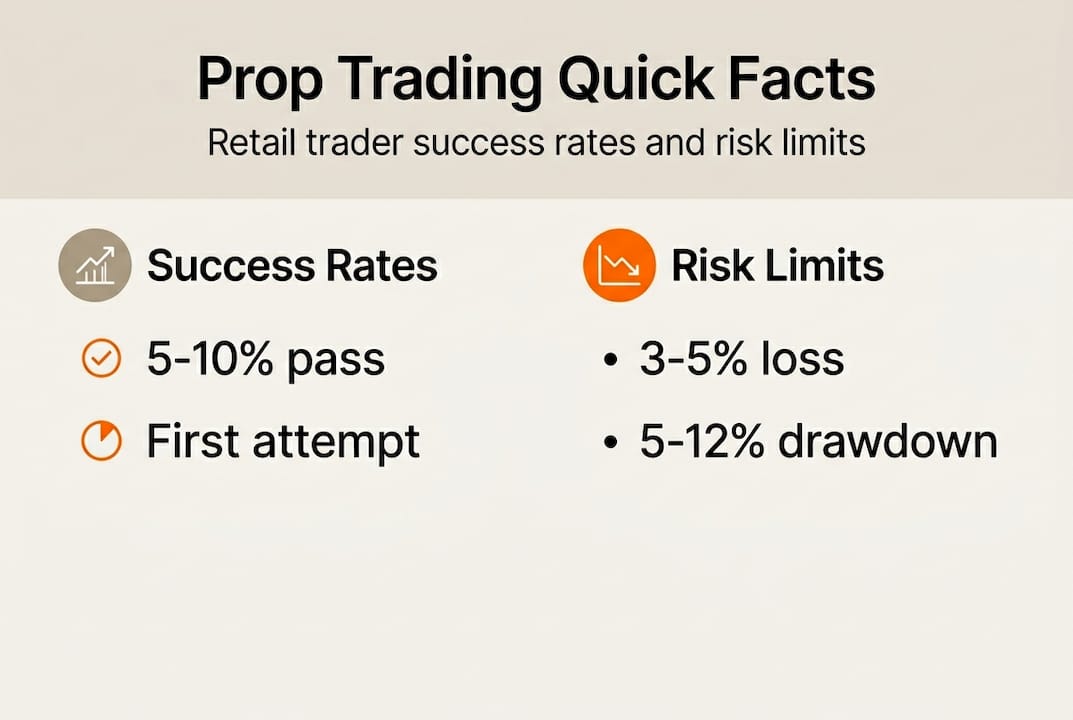
Industry research shows pass rates of 5-10% on first attempts, with most traders failing due to drawdown violations rather than inability to generate profits. The psychological pressure of strict loss limits causes many traders to overtrade or revenge trade after losses, quickly hitting maximum drawdown thresholds.
Even more sobering: approximately 7% of traders ever receive payouts from funded accounts. Many who pass evaluations fail to maintain discipline in live funded trading, violating rules or hitting drawdowns shortly after receiving capital. The average payout amounts to roughly 4% of the funded account size, meaning a $100,000 account typically generates around $4,000 in withdrawable profits before most traders lose the account.
Notable payout statistics include:
- Apex Trading paid out $598 million across its trader base
- FTMO has distributed over $100 million to successful traders
- Average monthly payout per funded trader ranges from $500 to $2,000
- Top 1% of traders earn $10,000+ monthly across multiple scaled accounts
The risk landscape extends beyond personal trading mistakes. Several prominent prop firms closed operations in 2024-2025, leaving traders without access to earned profits or funded accounts. Regulatory scrutiny increased as some firms operated in gray areas regarding financial licensing, leading to sudden shutdowns that trapped trader capital.
“The prop firm model works brilliantly for disciplined traders who treat it as a professional career, but fails spectacularly for those seeking quick money or unwilling to follow strict risk parameters. Success requires treating the funded account more conservatively than your own money.” Industry analyst on prop trading realities
Key risks to understand:
- Strict rule enforcement means minor violations can terminate funded accounts
- Some firms delay or deny payouts citing obscure rule violations
- Challenge fees are non-refundable even if you narrowly miss targets
- Firm closures can result in loss of earned but not yet withdrawn profits
- Psychological pressure of trading firm capital often degrades performance
The benefits and challenges inherent in prop trading create a high-stakes environment where preparation and emotional control matter as much as trading skill. Many profitable demo traders fail funded accounts purely due to psychological factors when real money (even if not theirs) is at stake.
Transparency varies dramatically across firms. Reputable operations publish detailed payout statistics and maintain active trader communities where funded traders share experiences. Questionable firms hide behind vague terms of service and frequently change rules mid-challenge, creating an unfair playing field.
Understanding these realities helps set appropriate expectations. Prop trading offers genuine opportunity for skilled, disciplined traders willing to invest time mastering both markets and firm-specific rules. However, it’s not a shortcut to easy money, and most participants never achieve consistent funded trading status.
Choosing the right prop trading firm and preparing to succeed
Selecting a reputable firm and properly preparing for evaluations dramatically improves your chances of passing challenges and receiving payouts. The prop firm landscape includes both legitimate operations and questionable providers, making due diligence essential before investing time and money.
Start by researching firms with transparent payout histories. FTMO has paid out over $100 million, while Apex distributed $598 million to traders. These proven track records indicate firms that actually fund successful traders rather than just collecting evaluation fees. Check independent review sites and trader forums for recent payout experiences, not just marketing testimonials.
Critical selection criteria include:
- Published payout statistics with verifiable trader testimonials
- Clear, detailed rules documentation without frequent changes
- Responsive customer support that answers rule questions promptly
- Reasonable evaluation fees relative to funded account sizes
- Transparent profit split terms without hidden fees or conditions
Trading style compatibility matters significantly. If you’re a swing trader who holds positions for days, choose firms offering static drawdowns rather than trailing drawdowns that tighten as you profit. Static drawdowns let you ride trends without premature stops from tightening risk parameters. Conversely, day traders benefit from trailing drawdowns that lock in profits.
Cryptocurrency traders should verify firms explicitly allow crypto trading. Some firms restrict trading to FX and indices, while crypto-friendly platforms like Velotrade offer Bitcoin, Ethereum, and altcoin pairs. Crypto volatility requires understanding whether firm drawdown calculations use mark-to-market or end-of-day valuations.
Pro Tip: Before purchasing any evaluation, practice the exact challenge rules on a demo account for at least 30 days. Use the same position sizes, profit targets, and drawdown limits you’ll face in the real challenge. This preparation reveals whether you can consistently trade within parameters before risking evaluation fees.
Common preparation mistakes to avoid:
- Jumping into challenges without practicing firm-specific rules
- Choosing account sizes too large for your experience level
- Ignoring psychological differences between demo and evaluation trading
- Failing to document your trading plan before starting challenges
- Overtrading to hit profit targets quickly instead of patiently waiting for setups
The evaluation process rewards patience and discipline over aggressive trading. Many traders fail by taking unnecessary risks after reaching 80% of profit targets, then hitting drawdowns trying to force the final 20%. A methodical approach that accepts slower progress dramatically improves pass rates.
Understanding why trading rules exist helps you embrace rather than resent parameters. Drawdown limits protect both you and the firm from catastrophic losses. Position size restrictions prevent over-leveraging. These rules mirror professional risk management at institutional trading desks, teaching discipline that benefits your entire trading career.
Managing drawdowns requires specific strategies. Calculate your maximum position size before entering trades, ensuring even a worst-case stop loss won’t exceed daily limits. Use proper risk management techniques like risking only 1% of account balance per trade. This conservative approach means you’d need 5 consecutive losses to hit a 5% daily limit, providing substantial buffer for normal trading variance.
Firm selection ultimately determines your prop trading experience. Invest time researching thoroughly, reading actual trader experiences, and testing rules on demo accounts. The right firm alignment with your trading style and risk tolerance makes the difference between frustrating failures and sustainable funded trading success.
Explore funded prop trading opportunities with DayProp
Now that you understand prop trading mechanics, success factors, and firm selection criteria, take the next step toward securing funded accounts. DayProp specializes in helping retail traders navigate the evaluation process with structured guidance and transparent funding models designed for FX, indices, and crypto markets.
Our performance-based evaluation process focuses on real trading skill rather than gambling behavior, with clear rules and professional risk parameters. Whether you’re new to prop trading or looking to scale existing funded accounts, DayProp provides the frameworks and support to improve your success rate.
Explore our comprehensive trading evaluation guide covering challenge preparation, risk management strategies, and common pitfalls to avoid. We also help you compare different funding models to find the best fit for your trading style and goals. DayProp bridges the gap between talented retail traders and institutional capital through education, discipline, and performance-based growth.
What is prop trading? Frequently asked questions
What exactly is prop trading for retail traders?
Prop trading means using a firm’s capital to trade financial markets after passing evaluation challenges. You keep 70-95% of profits while the firm provides funding and absorbs losses, allowing you to trade larger positions without personal financial risk.
How long do evaluation challenges typically take?
Most challenges have no time limits, letting you trade at your own pace. Aggressive traders might complete evaluations in 2-4 weeks, while conservative approaches take 2-3 months. Focus on consistency rather than speed to improve pass rates.
When and how do funded traders receive payouts?
Payout frequency varies by firm, ranging from weekly to monthly schedules. Most firms require minimum payout thresholds ($100-$500) and process withdrawals within 1-14 business days. Always verify payout terms before starting challenges.
What should I look for when choosing a prop trading firm?
Prioritize firms with published payout statistics (FTMO $100M+, Apex $598M), transparent rules documentation, and positive independent reviews. Verify the firm allows your preferred trading style and instruments before purchasing evaluations.
How is risk managed in funded trading accounts?
Firms enforce strict daily loss limits (3-5%) and total drawdown caps (5-12%) that automatically close positions if breached. These parameters protect both trader and firm from catastrophic losses while teaching professional risk management discipline.
Can I trade cryptocurrencies with prop firm capital?
Some firms explicitly allow crypto trading while others restrict to FX and indices. Verify instrument permissions before starting challenges. Crypto-friendly firms like Velotrade offer Bitcoin, Ethereum, and altcoin pairs with appropriate volatility-adjusted risk parameters.
Recommended