

Every experienced trader knows that earning a funded account takes more than a winning streak. Success hinges on a detailed approach to strategy and risk—especially when every move gets measured against strict performance metrics. With performance-based evaluations now the standard for serious FX and crypto traders, your systematic risk management approach sets you apart from the crowd. Understanding how to prepare, document, and execute your trading process is the first step toward securing significant capital and proving your discipline under real-world pressure.
Table of Contents
- Step 1: Prepare Your Trading Strategy And Risk Controls
- Step 2: Register And Configure Your Evaluation Challenge
- Step 3: Execute Trades Following Performance-Based Parameters
- Step 4: Monitor Progress And Adjust Tactics For Consistency
- Step 5: Validate Evaluation Results And Secure Funding
Quick Summary
| Key Point | Explanation |
|---|---|
| 1. Document Your Trading Strategy | A written strategy acts as a rulebook, guiding your decisions during volatile market conditions to prevent impulsive choices. |
| 2. Establish Risk Management Controls | Implement stop-loss orders, position sizing, and diversification to protect against significant losses and ensure sustainable profitability. |
| 3. Execute Trades Without Deviation | Follow your documented strategy precisely when entering trades to maintain discipline, avoiding emotional decisions that can lead to losses. |
| 4. Monitor and Analyze Performance | Regularly evaluate your trades through a detailed journal to identify weaknesses and refine your strategy for consistent improvement. |
| 5. Validate Results for Funding | Ensure you meet all evaluation criteria and maintain documentation to confirm your readiness for a funded trading account. |
Step 1: Prepare your trading strategy and risk controls
Before you enter any trade, you need a systematic methodology that defines what you’ll trade, when you’ll trade it, and how you’ll manage losses. This step establishes the foundation for everything that follows in your performance evaluation.
Start by documenting your trading strategy in writing. Your strategy should answer these core questions:
- What market conditions trigger your entries?
- Which instruments or asset classes do you trade?
- What is your profit target range?
- How do you identify your exit points?
Your written strategy becomes your rulebook. When emotions run high during volatile market moves, you’ll refer back to these rules instead of making impulsive decisions.
Next, build your risk controls framework. A systematic risk management approach that includes stop-loss orders, position sizing, and diversification directly limits potential losses and aligns your trading behavior with sustainable profitability. This isn’t optional—it’s the difference between traders who survive drawdowns and those who don’t.
Define your position size using the percentage-risk model. Calculate what percentage of your account you risk per trade (typically 1-2%), then determine your position size based on the distance to your stop-loss. A trader risking 2% per trade on a $10,000 account puts $200 at risk per trade. If your stop-loss is 50 pips away, your position size adjusts accordingly.
Set your maximum drawdown limit. Establish a threshold where you pause trading and reassess. Many traders use 10-15% as their maximum acceptable drawdown before reviewing their strategy. This prevents you from digging yourself deeper during rough periods.
Document your stop-loss placement rules and leverage limits before you start trading. Will you use hard stops that execute automatically, or mental stops you monitor? Will you adjust stops based on volatility? Write this down now, not during a trade.
Here’s a summary of essential risk management components for your trading plan:
| Component | Purpose | Typical Guidelines |
|---|---|---|
| Position Sizing | Limits exposure per trade | 1-2% of account per trade |
| Stop-Loss Placement | Defines maximum loss per position | Use hard stops based on volatility |
| Maximum Drawdown Limit | Sets pause threshold during losses | 10-15% account drop triggers review |
| Leverage Limits | Controls amplified risk | Choose leverage within your rules |
| Diversification | Reduces impact of individual losses | Trade multiple, uncorrelated assets |
Your strategy document is your trading constitution. Once you establish these rules, you follow them without exception during your evaluation period.
Pro tip: Test your strategy rules against the last 3 months of price data before submitting your evaluation. This quick backtest catches logical flaws and builds confidence in your approach.
Step 2: Register and configure your evaluation challenge
Now that your strategy is documented, you’ll move into the platform registration process. This step connects your trading plan to the evaluation framework where your performance gets measured against specific metrics and risk parameters.
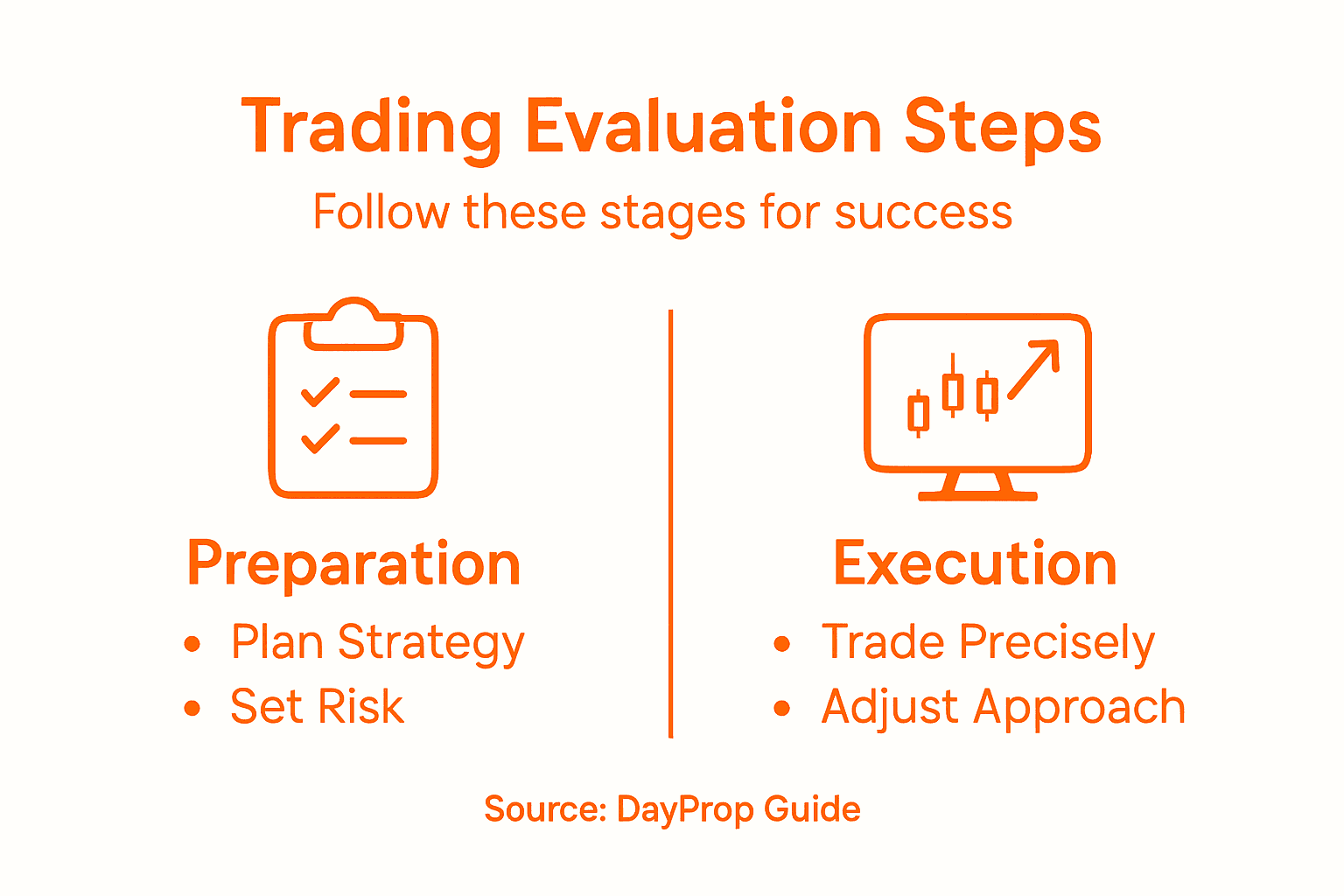
Begin by selecting your challenge tier. Most evaluation programs offer multiple account sizes based on your experience level and capital goals. Start with a tier that matches your confidence—rushing into a larger account before you’re ready adds unnecessary pressure.
Complete your initial submission by uploading your trading history and documentation. The platform will review your background to confirm you understand market basics and aren’t attempting to trade with unrealistic expectations. This verification step ensures all participants are genuinely prepared to trade professionally.
Next, configure your account parameters in the platform. You’ll set several critical values:
- Your maximum loss limit for the entire evaluation period
- Your daily loss threshold before trading pauses automatically
- Your profit target that signals completion
- Your leverage settings (if applicable to your challenge)
These aren’t arbitrary numbers—they directly enforce the risk discipline you outlined in your strategy. When you exceed your daily loss limit, the platform locks your account for the remainder of that day. No exceptions, no override buttons.
Staged challenge structures require traders to meet specific performance metrics without violating risk parameters to progress toward live funding qualification. If your program includes multiple phases, understand what you must achieve in Phase 1 before advancing to Phase 2.
Verify your platform setup thoroughly. Check that your stop-loss orders will execute automatically at your specified levels, your position sizing calculations are correct, and your account funding is active. A simple configuration error discovered mid-evaluation costs you time and opportunity.
Your evaluation challenge is a contract between you and the platform. The rules are absolute—there are no negotiation points once trading begins.
Pro tip: Paper trade your exact position sizing and stop-loss placement for one full trading session before submitting your live challenge, ensuring your configuration matches your actual execution style.
Step 3: Execute trades following performance-based parameters
With your strategy documented and platform configured, execution is where discipline meets reality. This step focuses on entering and managing trades exactly as your rules specify, without deviation based on emotion or market noise.

Your first priority is precision entry execution. When your trading signals align with your entry criteria, you execute immediately without hesitation. Hesitation costs you the best entry prices and introduces psychological uncertainty into your trading. If your rules say to enter on a break above resistance, you enter the moment price breaks that level.
Use automated order execution that triggers based on your predefined parameters rather than manual clicking. Automation removes emotion from the execution process and ensures your orders place consistently at the exact levels you specified.
Manage your position size according to your formula. Never size trades larger than your risk parameters allow, even if you feel exceptionally confident about a setup. Your position size is fixed—it does not change based on conviction or recent winning streaks.
Monitor your open positions against your predetermined targets:
- Your stop-loss level where you exit losses
- Your profit target where you take gains
- Your time-based exit if applicable (exit after X hours or days)
- Your trailing stop if you use one for trend following
Execution algorithms optimize order placement by managing trade timing and market impact in real time, dynamically adjusting based on conditions to deliver consistent performance aligned with your risk tolerance. Consider whether market-making algorithms suit your strategy, or if fixed-level orders work better for your trading style.
Do not move your stops in the direction of losses. Do not add to losing positions hoping to average down. Do not move your profit targets higher mid-trade. Your parameters are locked in place before execution.
Your rules execute trades, not your judgment. Judgment got you here; discipline keeps you here.
Pro tip: Set your stop-loss and profit target orders immediately upon entry, before the trade moves against you, preventing the temptation to adjust levels during drawdowns.
Step 4: Monitor progress and adjust tactics for consistency
Execution alone is not enough. You must systematically review your trades to identify patterns, spot weaknesses, and refine your approach. This step transforms raw trading activity into actionable insights that improve consistency.
Create a detailed trading journal for every trade you execute. Record your entry price, exit price, reason for entry, outcome, and what you would do differently next time. Over 20 or 30 trades, patterns emerge that pure statistics cannot reveal.
Analyze your performance using a trader performance review checklist that evaluates key metrics like profit-loss ratio, risk management efficacy, and execution consistency. This structured approach identifies your actual strengths and weaknesses rather than relying on gut feeling or selective memory.
Review these metrics weekly during your evaluation period:
- Your win rate (percentage of winning trades)
- Your risk-to-reward ratio (average gain vs. average loss)
- Your largest drawdown in a single trade or day
- Your trading frequency and whether it matches your plan
- Your rule violations (did you break any of your documented rules?)
When you identify a weakness, isolate the specific issue before changing your strategy. If your win rate is below your historical average, determine whether the market environment changed or your execution deteriorated. If your risk-to-reward ratio is poor, your exits may need adjustment rather than your entries.
Continuous monitoring enables traders to analyze winning and losing trades and adjust entry, exit, or risk parameters accordingly, ensuring your approach evolves with market dynamics and your performance trends. Make adjustments deliberately and document why you made each change.
Remember: your evaluation period is not the time for major overhauls. Small, tactical adjustments based on data are acceptable. Complete strategy rewrites signal that your initial preparation was insufficient.
Numbers don’t lie. Your journal and metrics reveal exactly what worked and what didn’t during your evaluation.
Pro tip: Review your trading journal every Friday, not daily, to prevent emotional overreaction to single losing trades or short-term downswings.
Step 5: Validate evaluation results and secure funding
You’ve executed your strategy, monitored your performance, and made tactical adjustments. Now comes the validation phase where your results determine whether you qualify for live funded capital. This step confirms your competency and unlocks access to real trading accounts.
First, confirm that you’ve met all evaluation completion requirements. Your platform will display your final metrics clearly. Verify that you achieved your profit target and that your account equity never breached your maximum drawdown limit. These are binary criteria—you either met them or you didn’t.
Review your complete trading record one final time. The evaluation process assesses your competency, risk management, and consistency under defined conditions, with validation involving your ability to meet profit targets while adhering to risk limits over specified periods. Platform administrators will conduct their own review, so ensure your record is clean and your rule adherence is documented.
Check for any violations or red flags:
- Did you exceed your daily loss limit on any day?
- Did you violate position sizing rules?
- Did you trade outside your approved hours or instruments?
- Did you execute any trades contradicting your documented strategy?
If you passed validation cleanly, your account status changes to approved for funding. You’ll receive notification that you’ve qualified and instructions for next steps. This is the moment your discipline gets rewarded.
Once approved, you’ll proceed to your funded trading account agreement. This outlines the terms of your live capital access, profit-sharing structure, and ongoing performance requirements. Read this agreement thoroughly. You’re entering a professional relationship with specific expectations.
Your funded account typically comes with its own risk parameters and profit targets. These differ from your evaluation parameters—they’re usually less restrictive since you’ve already proven yourself. Treat your funded account with the same discipline you applied during evaluation.
This table highlights differences between Evaluation and Funded Trader accounts:
| Criteria | Evaluation Account | Funded Account |
|---|---|---|
| Purpose | Assess discipline and skill | Trade with real capital |
| Risk Restrictions | Strict daily and total loss | Usually more flexible |
| Profit Target | Required to advance | May be based on payout thresholds |
| Performance Review | Automated and manual checks | Ongoing, periodic reviews |
Validation proves you can trade like a professional. Funding gives you the capital to scale.
Pro tip: Before accepting your funding agreement, confirm the exact profit split percentage, minimum monthly trading activity requirements, and any withdrawal restrictions so you understand the complete terms.
Take Control of Your Trading Evaluation Journey with DayProp
Mastering the performance-based trading evaluation process requires disciplined execution, precise risk management, and unwavering consistency. If you have followed the steps to prepare your strategy, configure your evaluation challenge, and execute trades with professional risk parameters, the next crucial step is finding a platform that supports your ambitions with transparency and scalable funding. This article highlights the challenges faced by traders striving to meet strict evaluation criteria such as maximum drawdown limits, profit targets, and tactical trade adjustments that must be executed without emotional interference.
Unlock your potential with DayProp, the proprietary trading evaluation platform designed exactly for traders like you. We specialize in identifying talented retail traders in FX, indices, and crypto markets who demonstrate skill, discipline, and real-world edge. Our structured trading challenges mirror the performance-based parameters outlined in this article to help you meet evaluation requirements confidently. With professional risk controls, fast-track payout models, and a commitment to long-term development, DayProp bridges the gap between your trading efforts and institutional capital without risking your personal funds. Start your disciplined path to funded trading today at DayProp and execute your trades with the confidence that every step is supported by a platform built by market professionals. Take the next step toward funding and professional growth now.
Frequently Asked Questions
What is the first step to master the Performance-Based Trading Evaluation Process?
The first step is to prepare your trading strategy and risk controls. Document your trading methodology in writing, outlining your entry conditions, instruments, profit targets, and exit points.
How should I set my maximum drawdown limit during the evaluation?
Set a maximum drawdown limit to pause trading and reassess your strategy, typically around 10-15%. This allows you to prevent further losses and reflect on your trading approach before continuing.
What parameters do I need to configure when registering for the trading evaluation challenge?
You need to configure your maximum loss limit for the evaluation, daily loss threshold, profit target, and leverage settings. Ensure these parameters align with the risk discipline outlined in your trading strategy.
How can I analyze my trading performance effectively?
Create a detailed trading journal to record your trades, including entry and exit prices, reasons for trading, and outcomes. Analyzing this data weekly will help identify patterns and areas for improvement.
What does the validation phase involve after completing the evaluation?
The validation phase confirms that you meet all evaluation requirements, including achieving the profit target and not breaching your maximum drawdown limit. Review your trading record to ensure it complies with all established rules before seeking funding.
How can I prepare for a funded trading account after the evaluation?
Once approved for funding, carefully review the funded account agreement, paying attention to profit-sharing structures and any ongoing performance requirements. Treat your funded account with the same discipline you applied during the evaluation process.
Recommended